

The Littles
Do fret the small stuff

Why are tiny things so compelling?
HOLEY MOLEY
This week I hosted the fourth biannual Sleepy Hollow Show & Tell for those lucky enough to live within a 10 or so mile radius. For those who don’t, a cutesy recap of my intro:
I say “cute” because I presented for once—I figured you can’t host a thing forever without playing the game yourself—and I don’t mean cute to proclaim my own cuteness; I mean cute because my object d’share was adorable. I love the word “adorable” because it contains “adore.” Worthy of adoration. A wonderful way to say I like you with way more romance-language-root oomph. J’adore! I adore itsy bitsy items. My object was this lilliputian leather-bound dictionary with a snap and no less than 18,000 words and definitions packed therein!
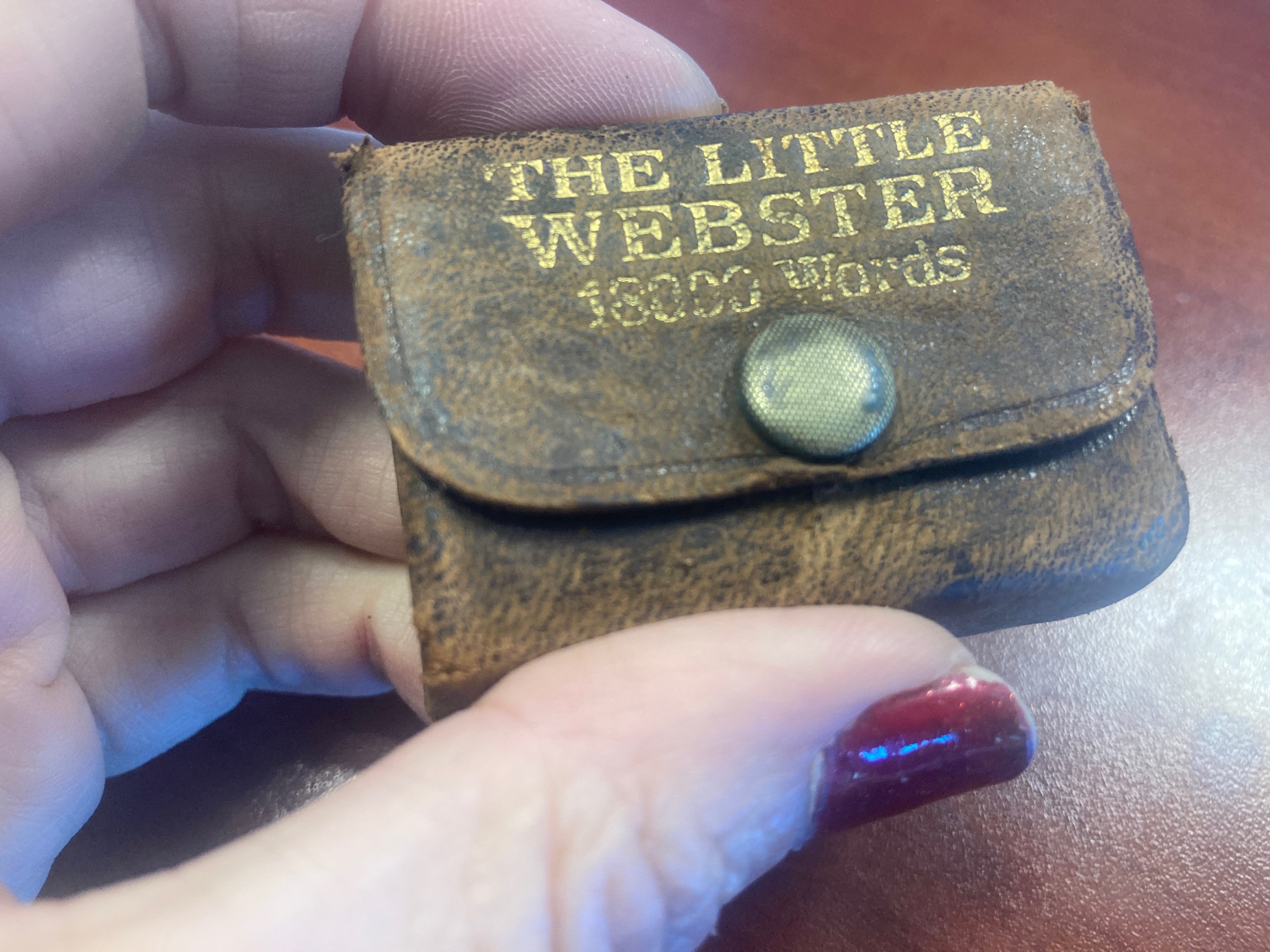
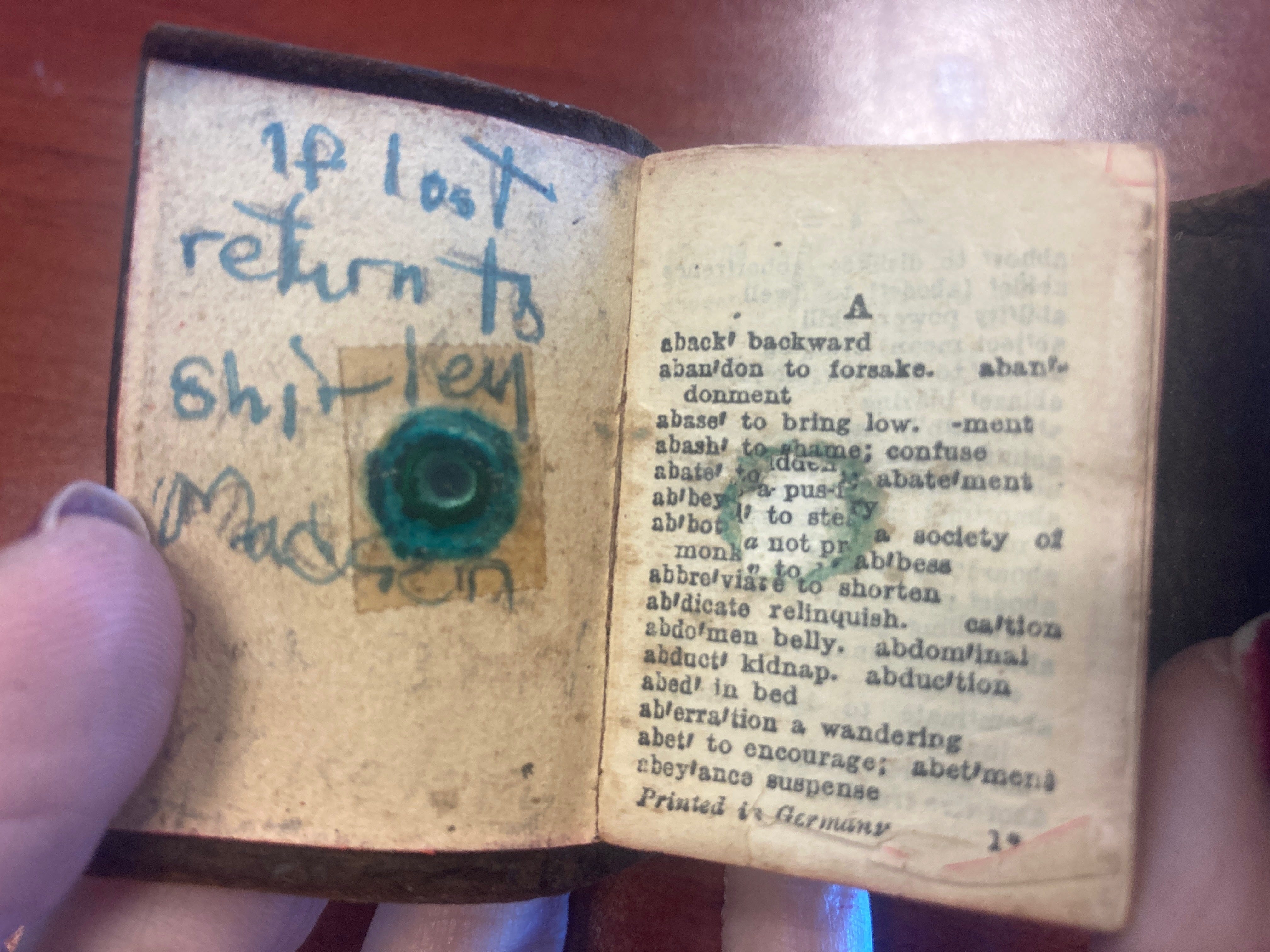
This precious Little Webster, as proclaimed in gold on the well-worn brown cover, dates back to maybe the late 1930s or thereabouts, I assume when my dad’s sister Shirlee (born 1929 in West Haven, CT) was gifted this and made her mark on the inside cover. “If lost return to Shirley Madsen.” Which is interesting to me because I know she was born Shirlee (and spent most of her life) with the double e’s determined by her Danish parents, but perhaps for some time period the fame of Shirley Temple might have made my dad’s older sister desirous of new more normal namesake. Had the young child rejected her Danish immigrant parents’ likely confused spelling and opted for the Temple type so popular then instead? I will probably never know as she has passed and so has my dad, but I’ll ask her daughter and daughter-in-law and report back.
In the meantime, this wee dictionary made it through her life and mine so far, as it somehow ended up on my childhood den bookshelves where I opened it and admired and adored it endlessly. How could they choose among so many more possible English language words to land on these special 18,000? And how to sharpen a definition into a just one or two words? What art of selection (and excision) this must have required. Surely this little treasure became part of the tapestry of words and books that formed my interest in being a writer someday.
Through the years, something like a cigarette burn hole appeared in the delicate first page. Closer inspection reveals it’s a greenish edged mark that became a hole etched through the friction of time from the circular pressure of the front metal snap. Now it’s something of a glory hole through which you see some letter bits from future words. I need my reading glasses to decipher this portal closer. There’s some kind of dark magic in there for sure.
QUESS WHAT
As I passed the tiny book around to the admiring audience of the S&T, I riffed some more on our attraction to such little things. What is it about these tiny objects that delight us so? Is it just girls who cherish doll furniture and faux wooden houses complete with tiny china and art the size of postage stamps? I once thought I found a great deal on a cabinet on eBay which shipped for suspiciously cheap until I realized I hadn’t notice the dimensions. It was a miniature model of furniture fit for a toy human not a real one. So much for our full-size living room.
I love world-building exercises, and I especially love the artists who create a dense, believable world full of tiny things. Like the sweet Marcel the Shell trilogy of short stop motion films narrated by comedian Jenny Slate. The moments where Marcel, a tiny shell plopped on plastic shoes with one plastic eyeball plugging its shell hole and a painted mouth, describes how he navigates a big world with his chosen objects. Guess what the bed was in my fancy hotel: a muffin. Guess what I use as a hat: a lentil. Skis are man toenails, beanbag chairs are raisins. Ingesting soda bubbles comes with the fear of launching into a float. The smells from a tennis shoe might knock you out. His brother killed someone by impaling him on a brush. And guess what his attempted pet is: a human hair leashed to a charming ball of lint.
AWE-FUL, AWFUL DETAILS
When we see these cute things, or even these lint balls in the world of Marcel, we want to “own” them or at least drag them around for a while. Come on, says Marcel, yanking when it gets caught on a table leg, I love you. There’s the little world-building that feels both delightful and treacherous in the story of fanciful writer Aimee Bender (another name with ee)’s “End of the Line.”
It begins:
The man went to the pet store to buy himself a little man to keep him company. The pet store was full of dogs with splotches and shy cats coy and the friendly people got dogs and the independent people got cats and this man looked around until in the back he found a cage inside of which was a miniature sofa and tiny TV and one small attractive brown-haired man, wearing a tweed suit. He looked at the price tag. The little man was expensive but the big man had a reliable job, and thought this a worthy purchase.
He brought the cage up to the front, paid with his credit card and got some free airline points.
In the car, the little man’s cage bounced lightly on the passenger seat, held by the seatbelt.
The big man set up the little man in his bedroom, on the nightstand, and lifted the latch of the cage open. That’s the first time the little man looked away from the small TV. He blinked, which was hard to see, and then asked for some dinner in a high shrill voice. The big man brought the little man a drop of whiskey inside the indented crosshatch of a screw, and a thread of chicken with the skin still on. He had no utensils, so he told the little man to feel free to eat with his hands, which made the little man irritable. The little man explained that before he’d been caught he’d been a very successful and refined technology consultant who’d been to Paris and Milan multiple times, and that he liked to eat with utensils thank you very much. The big man laughed and laughed, he thought this little man he’d bought was so funny. The little man told him in a clear crisp voice that dollhouse stores were open on weekends and he needed a bed, please, with an actual pillow, please, and a lamp and some books with actual pages if at all possible. Please. The big man chuckled some more and nodded.
Awe-ful details like the above “drop of whiskey inside the indented crosshatch of a screw” and “thread of chicken” along with, later, the way he gifts his pet with a pet—an ant in a cage inside of the cage—start seeping into just awful. The view of the big world around the little man is nothing if not daunting. How would he escape if “the doorknob is the Empire State Building. The backyard is the African veldt.” The big man starts messing with the little guy, which soon becomes abuse. Perhaps he might do so in ways that seem little to the big man but to the victim are huge. Why would the man torture him like this? For pleasure? To exert his power? Simply because he can? It even gets weirdly sexual in super-uncomfortable ways as the big man insists the little man reveal his penis, and then demonstrate how it works. The little man, to get through this task of getting off in front of a monster audience, takes his mind to a happier place:
The little man stayed on the sofa and thought of his wife, who would go into the world and collect the bottle caps strewn on the ground from the big people and make them into trays; she’d spend hours upon hours filing down the sharp edges and then use metallic paint on the interior and they were the envy of all the little people around, so beautiful they were and so hearty. No one else had the patience to wear down those sharp corners. Sometimes she sold one and made a good wad of cash. The little man thought of those trays, trays upon trays, red, blue and yellow, until he came in a small spurt, the orgasm pleasureless but thick with yearning.
Later he tries to send good vibes out to his kids and wife in the midst of his imminent demise:
With his breath clouding warmly over his hands, the little man waited, half-dizzy, to be killed. He felt his death was terribly insignificant and a blip but he still did not look forward to being killed and he sent waves of love to his wife and his children, to the people who made him significant, to the ones who felt the blip.
But he doesn’t die because the “big” (i.e. lonely, pathetic) man wants to see even more of the little man—where he comes from, his little people, how they live. He’s set free but there are predators everywhere.
He waited for a bird to fly down and eat him. Not the worst death, he thought. Usually the little people used an oil rub that was repellant-smelling to birds and other animals, but all of that, over time, had been washed clean off him.
He waits for, and rides, the tiny blue bus. The bus accepts him without money. The little people passengers can smell this recent history on him. These terrible scenarios aren’t unique. “All the little people around him could smell what had happened. They lived in fear of it every day. The newspapers were full of updates and new incidents.” Meanwhile, in bigville,
On the lawn, the big man thought the bus was hilarious and walked next to it for a block. Even the tires rolled perfectly. He thought how if he wanted to, he could step on that bus and smush it. He did not know that the bus was equipped with spikes so sharp they would drive straight through a rubber sole, into the flesh of the foot. For a few blocks he held his foot over it, watching bus stops come up, signs as small as toothpicks, but then he felt tired and went to the corner and let the bus turn and sat down on the big blue plastic bus bench on his corner made for the big people.
Finally, the beautiful ending that I didn’t share with the group because I didn’t want to share all this unearned when we hadn’t read/experienced it all. (And neither have you probably, so do read the whole story if you wish, painful and poetic as it is, before I bring you to the sad and lovely conclusion.)
“In exchange for seeing your village,” he said out loud, “I will protect you from us. I will guard your front gates like a watchdog!” He yelled it into the thorny shadows of hedges, down the gutter, into the wet heads of sprinklers.
All he found was a tiny yellow hat with a ribbon, perched perfectly on the yellow petal of a rose. He held it for a good ten minutes, admiring the fine detail of the handiwork. There was embroidery all along the border. The rim of the hat was the size of the pad of his thumb. Everything about him felt disgusting and huge. Where are the tall people, the fatter people, he thought. Where are the aliens the size of God?
Finally, he sat down on the sidewalk.
”I’ve found a hat!” he yelled. “Please! Come out! I promise I will return it to its rightful owner.”
Nestled inside a rock formation, a group of eight little people held hands. They were on their way to a birthday party. Tremendous warmth generated from one body to the other. They could stand there forever if they had to. They were used to it. Birthdays came and went. Yellow hats could be re-sewn. It was not up to them to take care of all the world, whispered the mother to the daughter, whose yellow dress was unmatched, whose hand thrummed with sweat, who watched the giant outside put her hat on his enormous head and could not understand the size of the pity that kept unbuckling in her heart.
How the tiny tables are turned when it’s the big man in the end who little people pity. The big man even pities himself. He feels shame, as he should. He wonders where are the creatures larger than him—to help put him in his place, I suppose. Some perspective is needed in order to better behave. Where are those aliens the size of God, indeed.
SHARP PARTS
Lately I am playing freaky fairy godmother (i.e. crazy cat lady) and fostering one batch of kittens after another in rapid succession. Some of them start out sweet but turn sour though we always still love them. They are of course the softest cutest beings, but their claws soon grow into painful points that dig into my flesh with their neediness, while their bellies can easily flip and emit puke or loose poops. They fart constantly. Nonetheless, each set surpasses the last in my estimation. These are the ones, the best ones, yes these, or more specifically this one, and then somehow we surrender them, and get another set, and another, and no this one is the one. Still, they have an expiration date when they return to the shelter for their operations and adoptions into real “forever” homes, bless their racing hearts.
Each batch seems to require more work as I assume more complications. Once there was the sickly duo I had to syringe back to health; having achieved that, I thought I could master the feral who don’t meow and repel affection. Of Mice and Men came to mind when I cornered kittens hiding behind the toilet bowl with one hand on each side so they had no choice but let me pet them, dammit! Then came the dutiful grey momma cat with her four hungry black beast-babies. She was award-winning with her sacrificial patience as they bit and tugged endlessly at her sore teats. She was only one-year-old herself, baby having babies. But the bored wisdom in her was profound if innate. I wanted of course to keep her with the Macbethian name of “Grimalkin” I gave her, like it or not, and I also wanted the most fragile of her kin who we considered our former Poe reincarnated because he looked and acted identical.
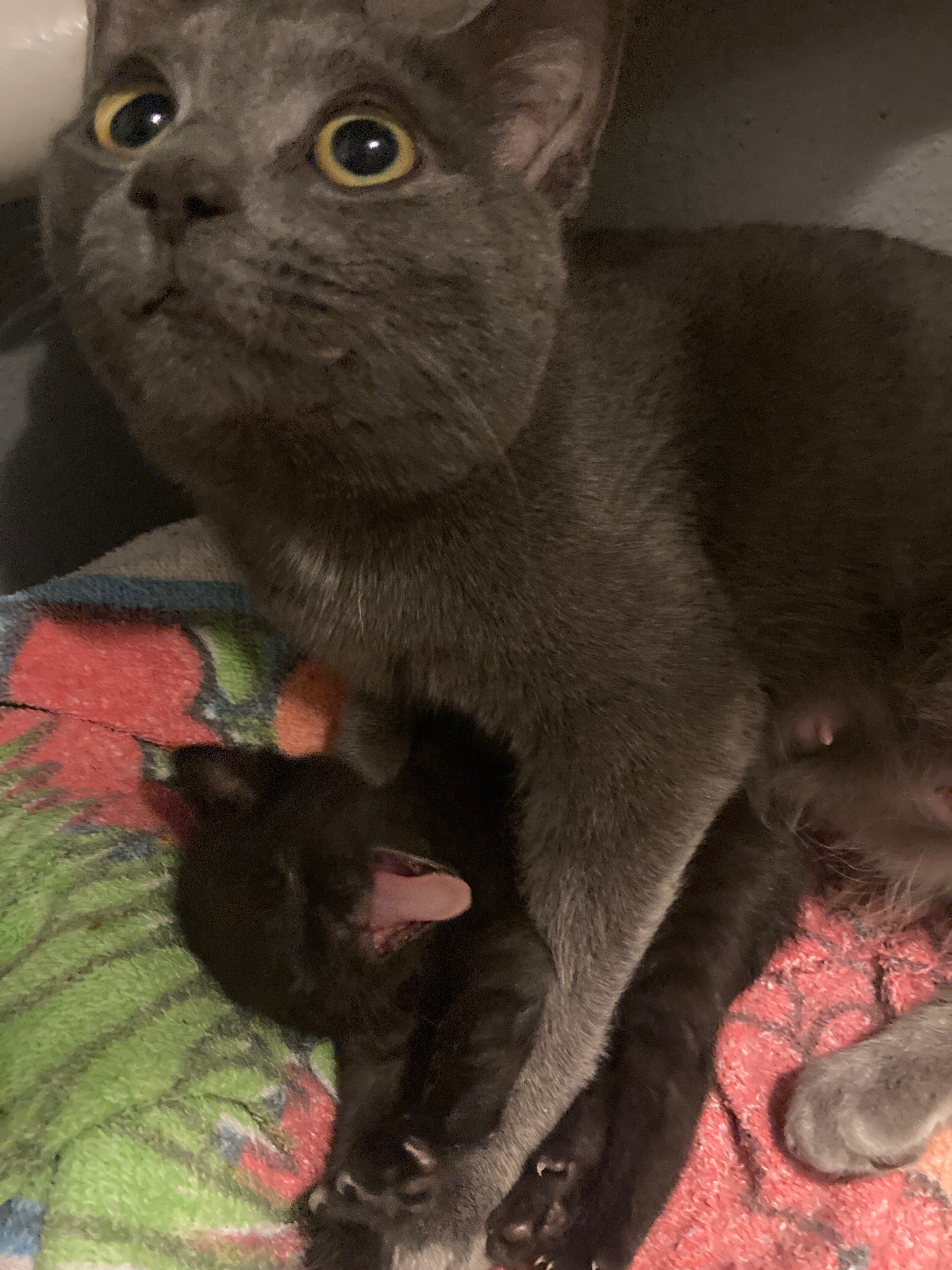
And when Gri-momma inevitably returned to the shelter along with two of four fat-enough kittens, the scrawnier ones were left behind for more of my awkward parenting. I could enjoy a further doting on Poe 2.0 while she shredded my legs climbing me like a tree trunk. Finally, set number four sets in, “the silver trio,” and one starts puking Monday which another takes up Tuesday.
This is my hobby now—scrubbing rugs, scooping poop, navigating a herd, doing my utmost to keep the most vulnerable alive. Perhaps a way for me to fill the dread-void I feel coming when my eldest flees for college in just mere months. I’ve got to stay busy. Keep producing. Do more than ever. Human the heck out of these little litters. Do they love us back? Or are we useful? Do they know they can use their adorableness to manipulate us into doing whatever they want? They own the household, holding my keyboard hostage as I try to type this right now.
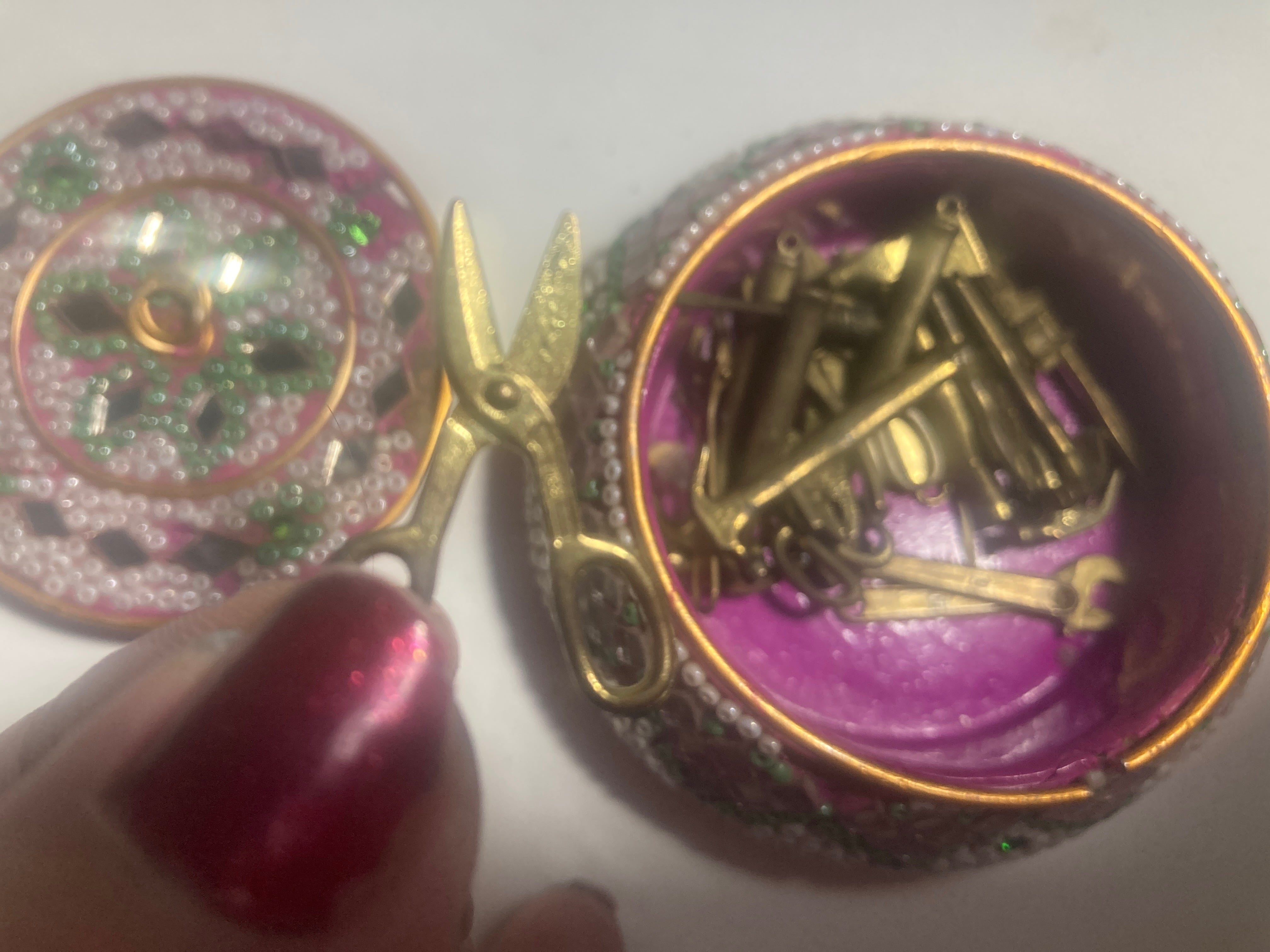
Perhaps in lieu of farty foster kittens, always temporary and yet perpetual, I could bring something else small and desirable to the next Show & Tell. Like these tiny tool charms with working sharp parts. These scissors really slice! I was obsessed with these golden pieces when I was a girl and I squirreled them away in a treasure box in between cutting tiny pieces of paper. The other day when I was cleaning my teen’s room (sometimes you have no choice but to mother against all odds), I found the same set there from my youth, being cherished. In a special box. In the special drawer.
Pride unbuckles in my heart. A piece of who I am and what I care about has rubbed off. I’ve left one good thing.
[Appreciate what I produce here but don’t feel like committing to a paid subscription? Spare some change to Buy Me a Book.]
*Blame all typos on kittens.
Oh Krista, this whole post mesmerized me and I couldn’t stop reading even when you moved on to part 2, lol and 3. I loved hearing about and seeing your precious tiny dictionary and then I could not adore more the Aimee Bender story which I read (and forgot about) a gazillion years ago, and then the kittens, the messy mothering, the impending losing which you know I share, and the tiny tool kit. All so beautifully written.