

Lilliputs
The little things that put us in our place, Part 2

I know I promised you a Motherless trilogy a few weeks back and left you pending after part 1, but continuing requires I finish reading Motherless Brooklyn—working on it. Consider this “Edge|Wise” project in general a long weave if you will. These threads will always find their pattern.
In the meantime, the sappy, scrappy Littles demand more attention. There are so many precious, persistent small treasures to riff on, I feel yet another series coming on. The tiny voices are collecting into a chorus, as the mewling foster kittens claw my calves into shredded cheese. Everyone wants to be heard.
THE SHOW (& TELL) MUST GO ON
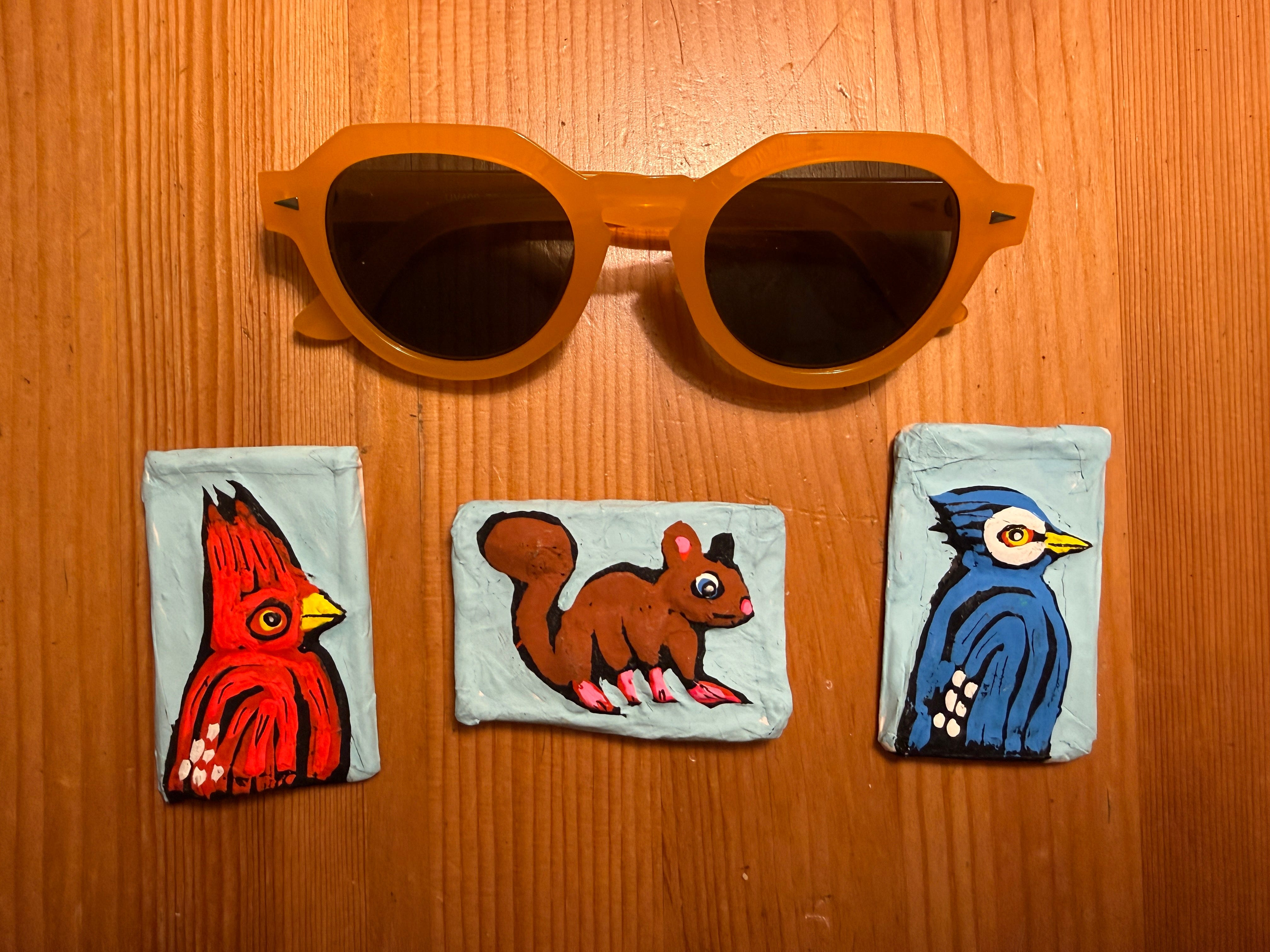
First, I hosted a Show & Tell to which many people came surprisingly unarmed with objects to share with their stories. Do we need to be schooled in how this kindergarten activity works? All ultimately fine, since everyone was game to share some pictures afterwards online which kept the conversation going and the community building. Even my friend who lives all the way down in the big city and didn’t come to the S&T was inspired enough by my essay to send a photo of his favorite small objects. Paper mâché pieces (with sunglasses to show size) he found at a thrift shop. So here you go: bird by bird (by way of squirrel):
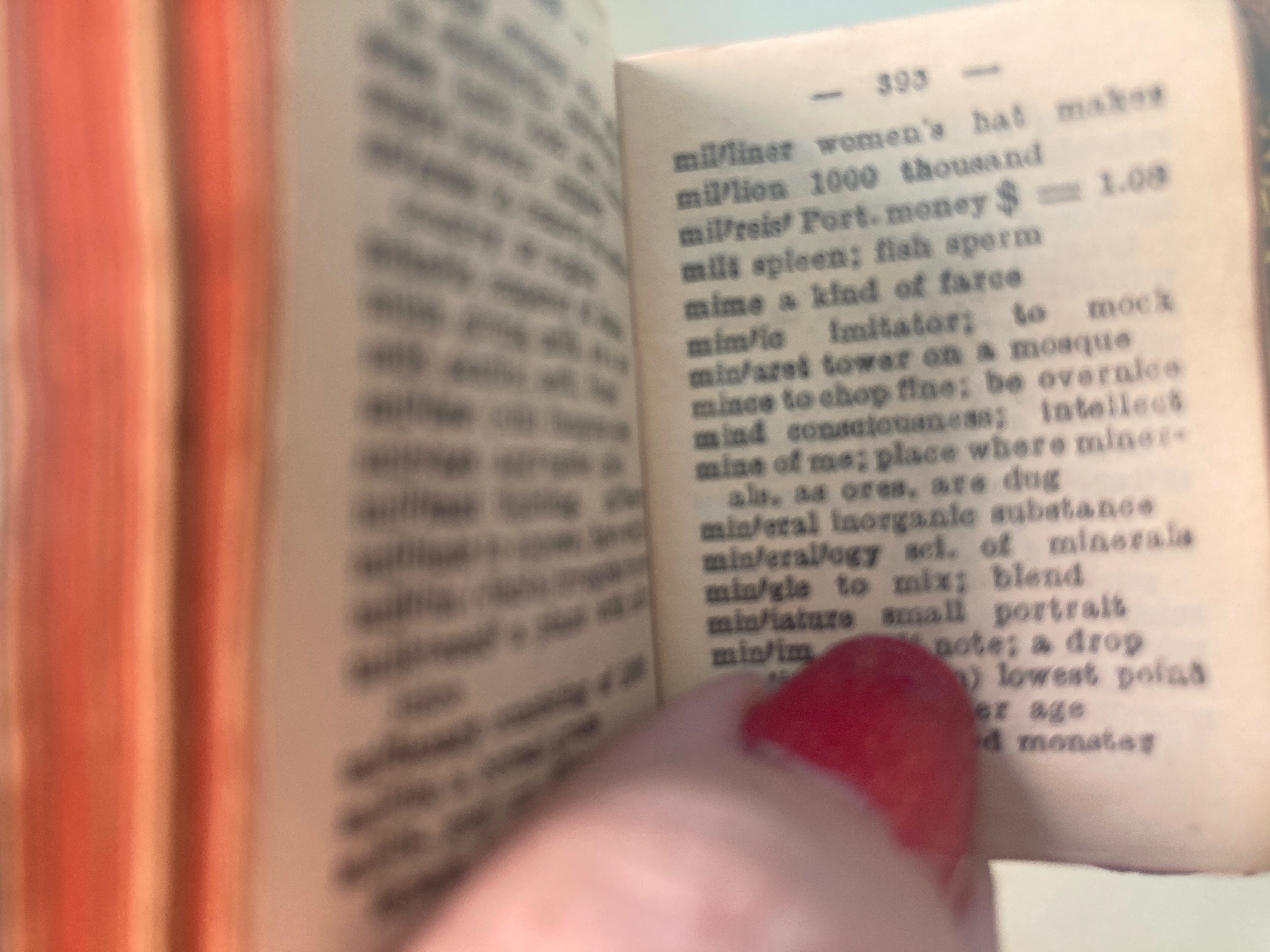
Re: the lilliput Webster where my Aunt Shirlee is inscribed as Shirley. It’s funny what a name can stir and how flexible can be its interpretations. I realized after posting that the handwriting was likely my father’s. It just feels like something he would have done: man-handle his big sister’s little book and put her name in it, but spell it wrong in the process. And also, very typical that when she gets really old, for this tiny leather-bound book of words to end up in our house when he helped empty out her house, because that’s what our hoarder house did: it absorbed. I remember when she was aging, clearly in a wig with some longer straight stray hairs coming through the short fake curl, that we visited her cool homemade house on stilts in swampy coastal CT as she was preparing to settle into an apartment for the aged. But I remember the dictionary many years before that, so I’m not sure about this timeline. I asked the closest relatives who have more ambivalence or diplomacy than I do.
Aunt Shirlee’s daughter-in-law says: “I always spelled her name Shirley. At this time I can’t think why or how your dad ended up with it. Your father was a collector of miscellaneous items and maybe when Shirley had to downsize moving into an ‘apartment for the elderly’ she gave it to Elmer?”
And her daughter says, from The Villages, Florida, knee deep in poodle and flowers: “My mom used Shirlee but there were times when I saw her name as Shirley… Not sure why…”
So that wasn’t very elucidating but it fascinates me how fluid a name might be, and how my aunt, and others, might randomly shift between spellings, or just not care. And always, how pervasive my father in stories that should have nothing to do with him.
NO END OF THE LINE
Remember “The End of the Line” story I shared where the little man is forced to masturbate in front of his big man abuser (among many other terrible things)? Who can forget! Well, I then discovered that The End of the Line also lives on in a little film, featuring the guy who plays that hilarious Russian in Stranger Things and a plethora of set designers that includes four “giant penis fabricators.” What a world, what a job!
Whether this is comedy or weird torture porn, you tell me. The comments I found online seem undecided surrounding the 2018 release. “Upsetting in ways I could have never predicted,” one viewer shares. Right down to the little pink piles of throw up, the whole thing is available on YouTube here, but trigger alert, the whole thing is a trigger alert.
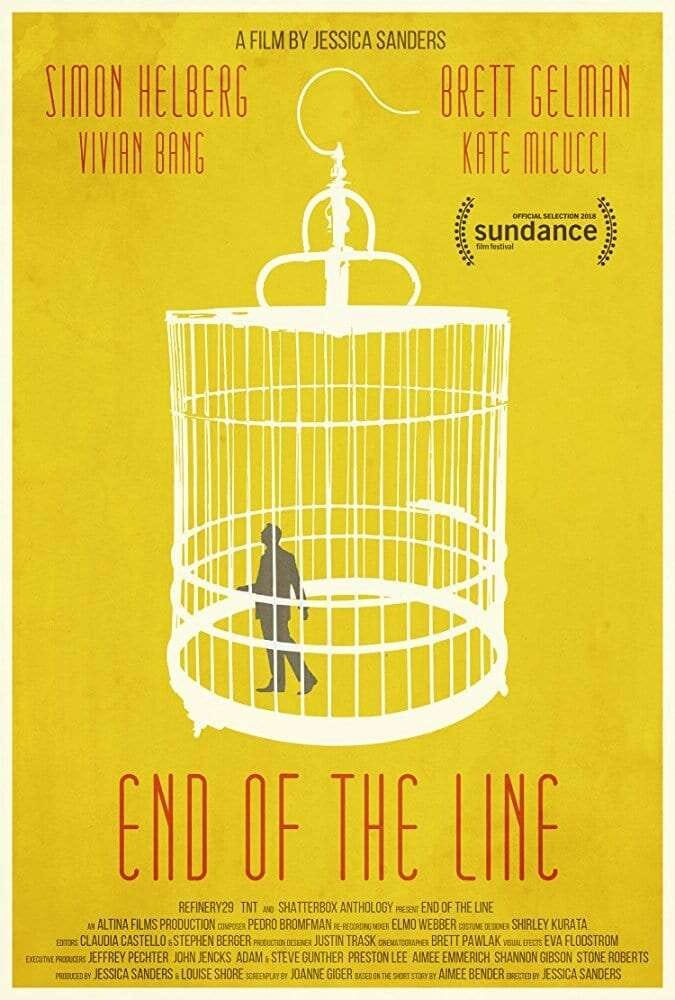
From the film’s website:
END OF THE LINE is a short film directed by Jessica Sanders (Oscar-nominated, Sundance and Cannes winner) based on acclaimed writer Aimee Bender’s surrealist short story about a lonely man who goes to the pet store and buys a tiny man in a cage. The story explores themes of power and abuse of power in a highly creative and unusual way. Starring Simon Helberg (Big Bang Theory, Florence Foster Jenkins) and Brett Gelman (Stranger Things, Lemon).
END OF THE LINE premiered at the 2018 Sundance Film Festival, screened in over 40 festivals around the world, and won Best International Film at the Molise Film Festival in Italy and the Jury’s Choice Award at the Discovery Film Festival in London. The film is part of Refinery29 & TNT’s award-winning Shatterbox Anthology, a short film series dedicated to supporting the voices of female filmmakers.
It helps on some level that the story was written by a woman and directed here by one, but this gender dissonance might also make it even harder to stomach. As I watched, and cringed, I recognized from Gelman’s other roles the almost maniacal/nervous laugh the big man emits when he’s angry, turned on, amused, annoyed. He is all of those things with his handy scapegoat, the little man, who tries to reveal his specific humanity to get sympathy (“You know I’m a man too, I’m just a little man; even if you don’t like me, it still hurts!”) to no avail. A side plot clearly reveals this scapegoatery when the big man goes to work with a rose/bottle of wine for his pretty colleague who rebuffs him immediately and of course the man comes home more prone to play with a small thing. “I paid a lot of money for you!” (namely $1,250 says the hanging tag in the old-timey bird cage) he screams bitterly when the little man doesn’t easily comply. Kind of like a man who when paying for a nice restaurant meal on a date might expect to “get some.” Big man goes as far as to put the little man down his pants, and more, and then when that’s not fulfilling enough, he wants to see the little man’s wife, and his children.
“No, I’m the end of the line for you,” little man responds.
Somehow this all feels so much harsher in the focused lens of movie-making, without the buffer of the linquistic magic of someone philosophical and fantastical like Aimee Bender to guide us. In her story, we can feel slightly elevated that we are somehow on the good side of this, at a distance of sound moral judgement. A wise and removed reader! The man is made to feel shame, and the little people win in a way. We can cheer with them. Bad big man! (Not us). In the film, we are more implicated, enjoying the show—even if it’s just icky and we can feel icky for participating somewhat equally as complicit, as audience. There’s no rousing ending at the end of the line, no hope or redemption. Just a: What have we seen/done?
From Substack’s “One Sentence,” a piece on the story that inspired this by Ben Dolnick:
“When the little man’s back was turned, the big man snuck a needle-thin droplet of household cleanser into his water and watched the little man hallucinate all night long, tossing and turning, retching small pink piles into the corners of the cage.”
Oh! No matter how many times I read this sentence [from Bender’s story], it never fails to shock me. The grimly sober, torture-report language: household cleanser, hallucinate, retching. The precise and plausible sadism of that needle-thin droplet. And then those small pink piles — which, with their incongruous adorability (is this the daintiest vomit in literary history?), keep us at least partially grounded in the premise. This is still a doll-house world; it is also a world of genuine cruelty and suffering.”
Which reminds me of what we were talking about in Motherless, actually. So maybe this topic isn’t so far removed in the long-weave. Often it’s the little ones, the young ones, the vulnerable ones, who are manipulated in this way. But on the Motherless website, it was the men’s very wives who were drugged and raped while unconscious, the strong mothers of their children, the ones they supposedly loved. So you might just start to think: no one is safe.
FAR FROM EMPTY SHELLS
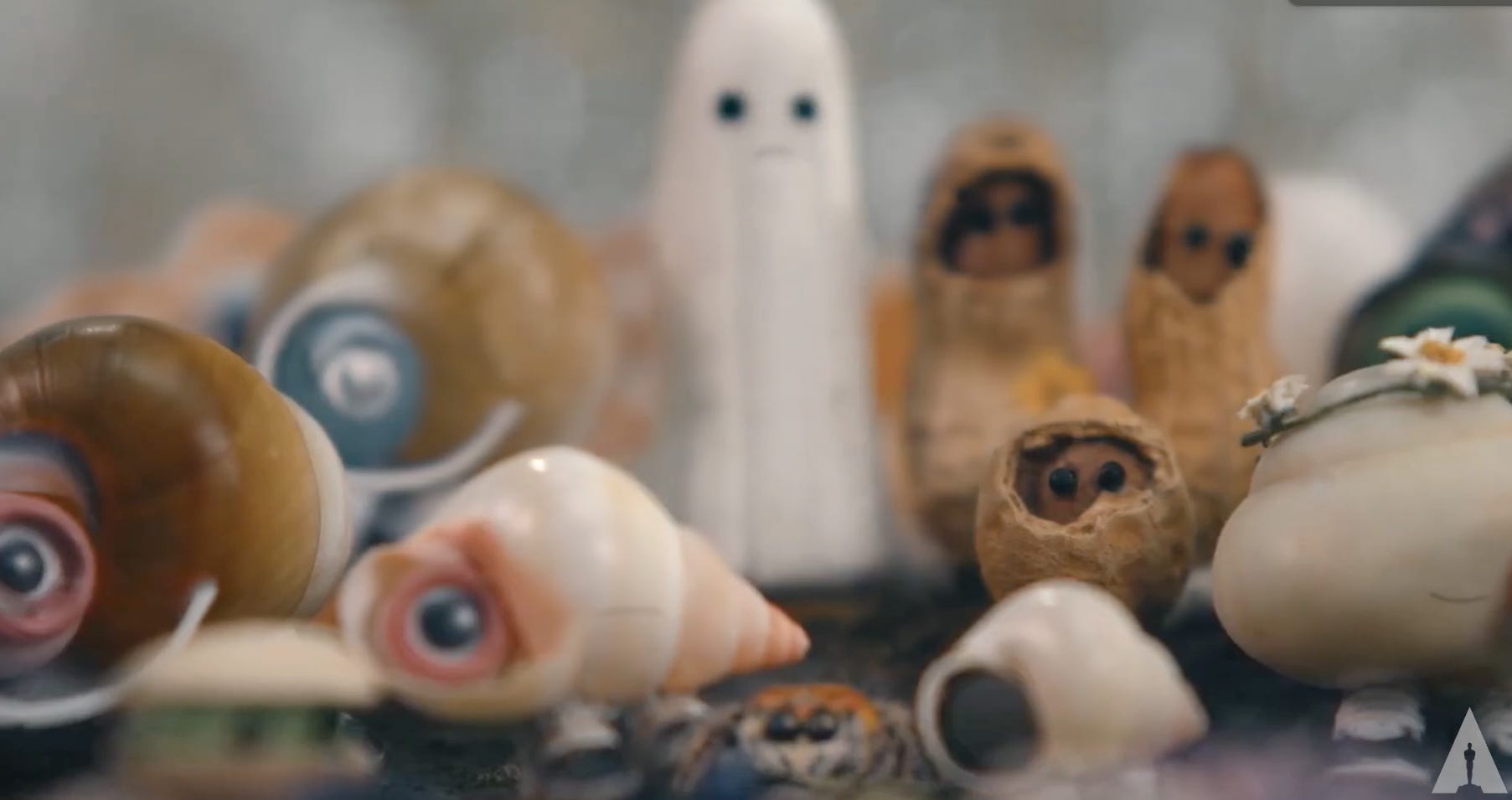
Continuing on my little world-building bender of late, I finally watched the full length Marcel the Shell With Shoes On (2021), care of my library on DVD, which was as good as I hoped, and sadder and deeper than I imagined. And comforting. It’s astounding how much humor, pathos, and affection a shell with plastic shoes and googly eyes can invoke when you can better witness him in his full environment, rendered not via cruel voyeur but sympathetic soul. There’s a great longing in the movie, and you can feel the prescient theme leaking through the full six years they made this to the pandemic era when it finally came out, that keyword “Community” lost and re-imagined was going to matter most.
We learn about Marcel’s predicament, alone with only his grandma in a house devoid of regular human inhabitants (just occasional anonymous AirBnB guests and a cleaning lady) until a kindly filmmaker comes along and finds Marcel’s situation fascinating enough to document. On the margins of this structure are the ghosts of broken relationships and marriages. The human couple that fought and broke up, traumatizing the one thriving “community” of little animated things who took cover for safety and got accidentally swept up into the leaving man’s luggage, and the end of the filmmaker’s marriage that brought him here to this now temporary rental. Grandma Connie wanders off and dies somewhere (evaporates into thin air?), and Marcel is tragically alone…until a viral search finally leads to a big weird reunion where he finds his long lost kooky crew.
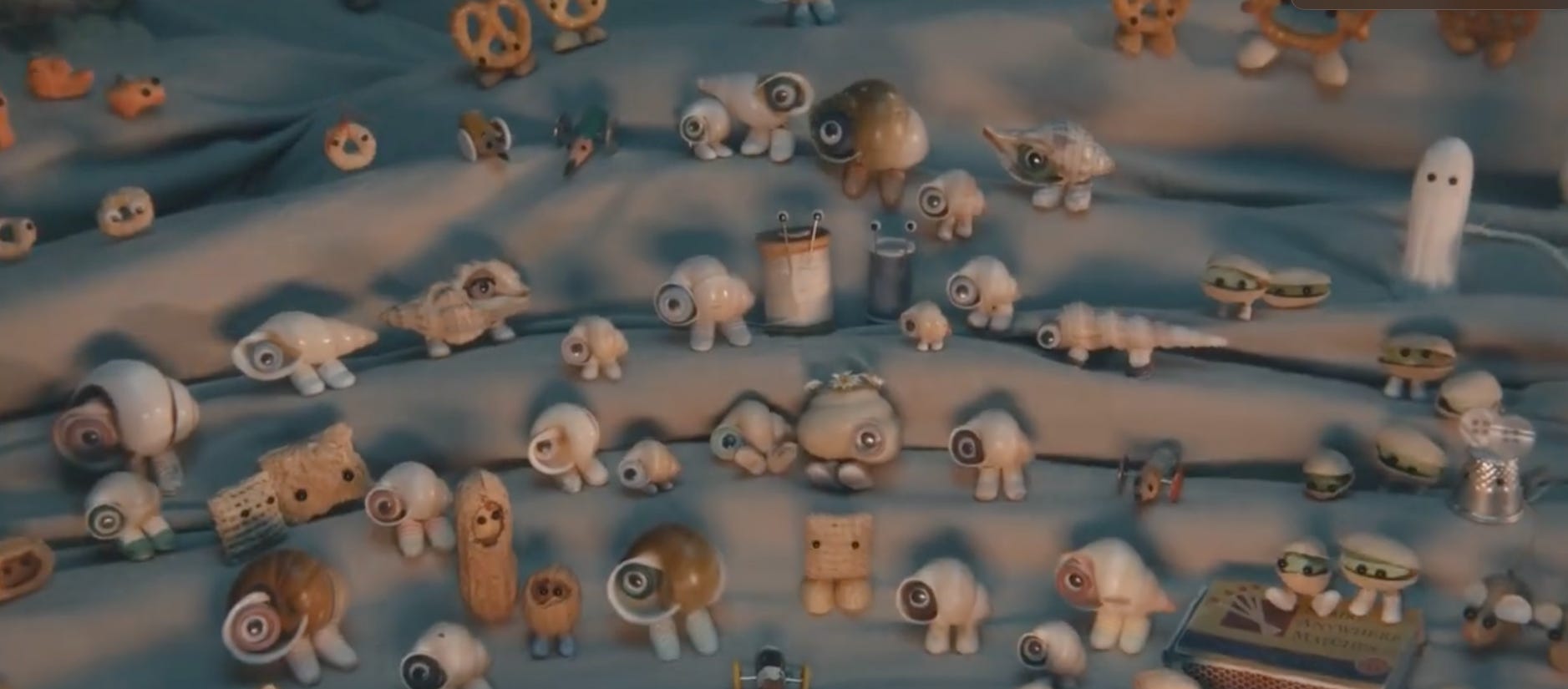
When I meet the expanded community on the couch, jumping with glee, suddenly my questions are organizational and mechanical but also sociological and even spiritual—world-building ones again. What are the rules of this tiny kingdom, or more accurately, how do these random things get animated. I don’t mean animated by film technology and dozens of shell fabricators but in the universe of Marcel’s “reality”: what is the animus that might bring such random objects to life?
Within this family reunion are the unlikely characters of pretzels, peanut shells, pencils with wheels, and a TAMPON ghost! I was so intrigued by that ghost, not realizing at first glance what it was, until it appeared again with a rear view and you can see its “tail” string. What the holy haunting heck—are these objects just assembled from the detritus between couch cushions rather than born and bred? What brings them to life? How do they come to be? I soon realize from my movie-watching and my Reddit scouring that these are questions both irrelevant and irreverent. We don’t need a prequel to know how a seemingly empty shell holds a soul—it just does. It’s also not important why or how the community is full is freaks, but that it is indeed a joyous beautiful community of freaks.
So we can at least still go down the insanely deep rabbit hole of how the creators create this film, a film that got made first in audioplay (recording much more voice clips from actors than they’d ever use in real documentary style), then animatic (hand-drawn story board which in and of itself took three years!), live action and finally animation (like recreating couches for the stage sets for these tiny puppets). This film rivals in world-building the complexity (and budget) of something like Inception and creates a universe so believable and touching that here even Marcel’s little carsickness vomit from his perch on a map on the dashboard is charming. A look behind the scenes is worthwhile to appreciate the extreme care that went into all this, and how the heck the objects were assembled and came to life (at least on film), including that lurking tampon.
WORLD-BUILDING, EGG-BREAKING
Since I employed the word lilliput earlier, I am of course inspired to look it up. Who knew that Lilliput is one of two fictional islands (along with Blefuscu) that appear in the 1726 novel Gulliver’s Travels by Jonathan Swift? Oh to make a place that stirs enough that it inspires a word that endures. From Wikipedia:
The two islands are neighbours in the South Indian Ocean, separated by a channel 800 yards (730 m) wide. Both are inhabited by tiny people who are about one-twelfth the height of ordinary human beings. Both nations are empires and the capital of Lilliput is Mildendo.
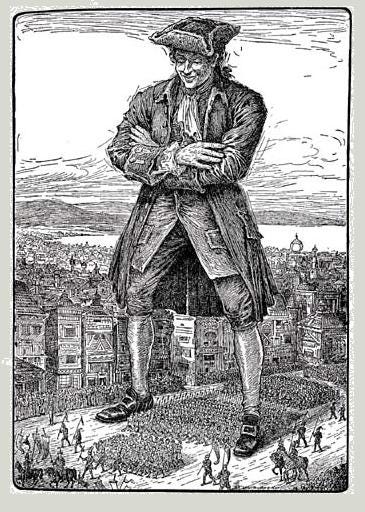
Descriptions of Lilliputians seems light on the fact of their tantalizing littleness and big on the politics, sadly. In particular there’s this weird warfare history surrounding the breaking of eggs, of all things. If you want to build a world, as I’ve riffed on before, first you have to destroy.
The novel further describes an intra-Lilliputian quarrel over the practice of breaking eggs. Traditionally, Lilliputians broke boiled eggs on the larger end; a few generations ago, an Emperor of Lilliput, the Present Emperor's great-grandfather, had decreed that all eggs be broken on the smaller end after his son cut himself breaking the egg on the larger end. The differences between Big-Endians (those who broke their eggs at the larger end) and Little-Endians had given rise to “six rebellions ... wherein one Emperor lost his life, and another his crown.” The Lilliputian religion says an egg should be broken on the convenient end, which is now interpreted by the Lilliputians as the smaller end. The Big-Endians gained favour in Blefuscu.
On that note, I end not with the breaking of eggs but with the state of my legs, because even (especially) the cutest kittens have claws that leave marks. They want to be as close to me as possible, I am an important member of their community; or I am a tree, a ladder, a scratch post to painfully destroy bit by bit. This is still a doll-house world; it is also a world of genuine cruelty and suffering. Is it cat scratch fever? Will it kill me? Are they trying to write me a message I need to decode?
We took a respite from fostering for a moment. Today’s Show & Tell, on the mend:
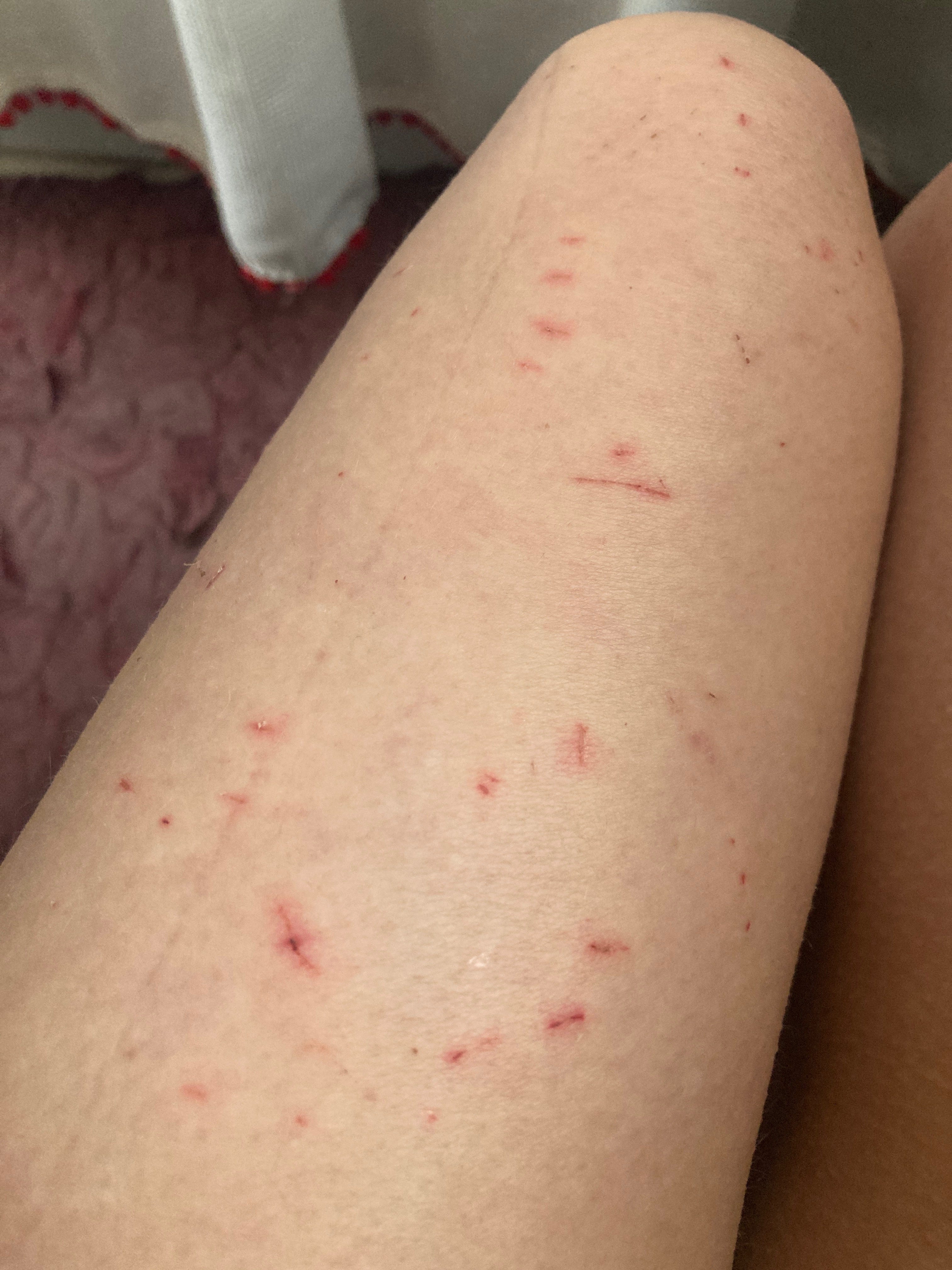
Love hurts.
[Appreciate what I produce here but don’t feel like committing to a paid subscription? Spare some change to Buy Me a Book.]