

In/scrutable
Are lighter eyes easier to read or too much to bear?

Last week I had fun going to the dark side—as I often do—this time, exploring pupils. How those black discs might expand in moments of murderous or sexual excitement to crowd out almost the whole iris, giving the viewer the illusion that these wild eyes have gone completely dark.
But what about those irises? The kaleidoscopic complexity of colors available to humans through nothing more than DNA (or tinted contacts) might to some signal beauty or emotional depth or…too much to bear.
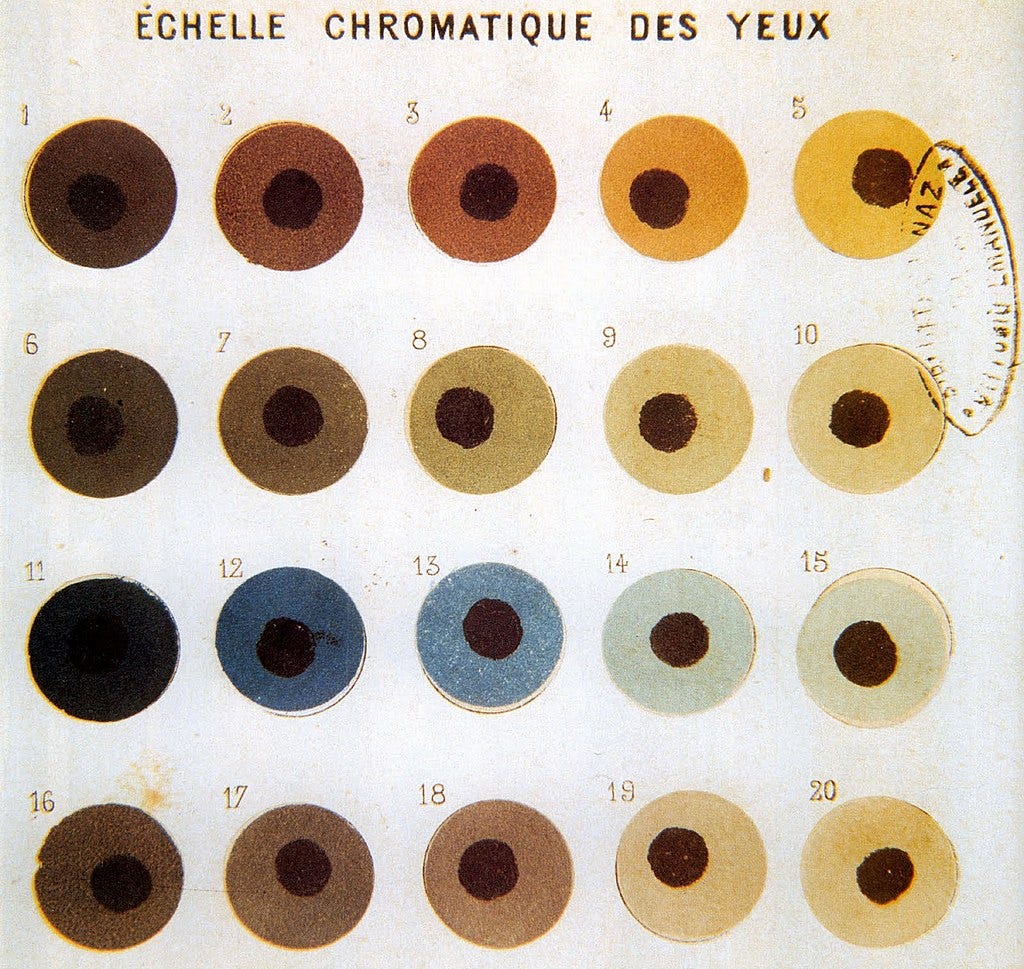
My friend said something interesting the other day, which happened to add a new layer to riff on my eyeball theme of late. He suggested lighter colored eyes are easier to “read.” I immediately thought of a Filipino boyfriend I had many years prior—how his fully dark eyes were like monotone marbles to me, shiny, opaque and lovely if somewhat inscrutable. It occurred to me that lighter eyes—with their greater contrast between iris and pupil—might seem more intense through this juxtaposition and somehow more decipherable and emotionally compelling.
I’m lately into doing a four-minute staring contest with an intimate partner in the edging-toward-boyfriend stage of early dating. It’s both intimidating and exhilarating to try to stare unflinchingly into this most private/most public space of our precious eyeballs, while, gasp, they might be doing the same to mine. It’s so confronting, so vulnerable. Will they see in there the great mass of my fear, or traces of the magic song of the inner child before the self-consciousness (and grade four eyeglasses) set in? The recklessness or the shame? The imposter syndrome or the genius? Will I likewise detect in them something secret, spicy, or scary?
What do everyday irises, when not over-runneth with black pupils, have to tell us? Could these ancestrally bequeathed color rings really be that rich? We can only measure their power in the interplay between the two parts, aperture and dispersed. If our eyes are the windows to the souls, the pupils let the light in, while the iris encircling might provide the Shakespeare.
My friend and I surmised in this iteration of the staring game, that each of us has one evil eye, the one on the left. Soulmates? In the shadowy light of dusk we were working with, it seemed as if one pupil of his had gone oblong, a bit reptilian. It was surely just another mirage. Meanwhile, in my left eye he detected the same. If not snake exactly, some edge. I forgot to put the sound on the phone’s timer so the four minutes went on interminably until we couldn’t take it anymore. Is it possible that if both our eyes were darker hued, we’d just glaze over this event easily in the shadows, but since we are mutually light-eyed, we had plenty of shape-shifting to search and believe we saw?
Studies show people tend to perceive brown eyes as more soothing, trustworthy. While pastel eyes are psychologically linked to assumptions about deceptiveness, cool, distance. These same studies also show that these eyes rest on faces that are also read and misread as all these features form a composite inextricably linked. “We concluded that although the brown-eyed faces were perceived as more trustworthy than the blue-eyed ones, it was not brown eye color per se that caused the stronger perception of trustworthiness but rather the facial features associated with brown eyes.”
On a Subreddit for neurodiversity someone admits darker eyes are easier for them to look at since you don’t know the line where the pupil ends and the iris begins. Making direct and prolonged eye contact can be intimidating for anyone, but for someone with autism, for instance, this level of engagement might be completely overwhelming. And, interestingly, this might be especially pronounced when you’re dealing with lighter hued irises.
One post starts with this question:
This sounds freaking ridiculous but I just want to know if other people have this weird affliction. It feels nuts to even type out.
For reference, I have autism, ADHD, and OCD. There’s no problem making eye contact with people who have brown eyes, in fact I tend to overdo it, but with blue-eyed people it’s very uncomfortable. It doesn’t even matter what our relationship is, like it’s easier for me to look a brown-eyed stranger in the face than my brothers, who have blue eyes.
Which is followed by no less than 46 commenters who did not at all find this ridiculous:
I’m autistic and just had a doctor’s visit with a doctor who had at least light eyes if not blue. I found it very uncomfortable to look him in the eye because everyone in my family has brown or dark eyes. It’s not creepy or strange to me, it just feels like light eye colored people “see” more when looking at me, probably just my mind getting uncomfortable because they are more piercing than dark eyes. In general, I don’t like looking people in the eye, and I feel better when looking away because if I can’t see you, you can’t see me type of feeling, but I have less of a problem with brown eyes than blue eyes for some reason.
I have hard time keeping eye contact with people that have light colored eyes, I have to break eye contact constantly to keep from going nuts. It’s not that the eyes scare us, it just triggers anxiety and self-awareness.
I have a feeling it has to do with how pupils dilate and how different colors appear. I know exactly what you’re talking about. I’m much more comfortable looking into the eyes of my brown eyed friend because brown eyes make the size of the pupil harder to distinguish. It all blends together. When I make eye contact with my blue eyed bsf, especially in bright lighting, her pupils will look so small, which is pronounced because of her eyes being so light. Small pupils generally indicate more light coming in and more focus, which might be why you feel more “seen,” thus uncomfortable.
Could it be that with lighter eyes, it’s not what we see exactly as how we might feel disturbingly more seen?
People tend to find larger (dilated) pupils more attractive, all the better to see when the irises around them are lighter. You can readily surmise the extreme opposite from this picture below (and empathize with all the neurodivergent above) in the pinprick pupil of bright daylight or perhaps something that resembles an insane person. Please stop shooting laser beams and let me be. Then again, the other model might be high on murder or mushrooms for all we know. This is indeed quite complicated.
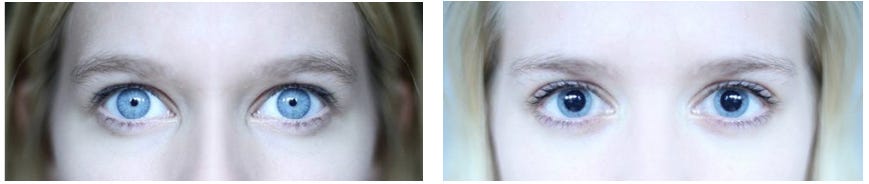
Dilated pupils (mydriasis) happen for all kinds of reasons. Mydriasis by definition means larger pupils than normal, i.e. taking up more eyeball space than the iris.
From the Clevelandclinic.org, the most common causes of dilation are, beyond an obvious absence of light/sunlight:
An eye exam (eye drops used to examine nerves and retina)
A reaction to medication (antidepressants, antihistamines, anti-nausea, anti-seizure, atropine, botulinum toxin, meds for Parkinson’s disease)
A brain injury
The use of recreational drugs (cocaine, ecstasy, LSD, methamphetamines, psychedelic mushrooms)
Sexual arousal (increased production of oxytocin hormone)
Adrenaline
The big-pupilled among us might also be in love, anxious, lying. Without a drug test and/or a lie detector how is one to know? In any case, we must find all this intriguing enough to want to look further—if we can stand it.
And, just to up the eyeball ante to the 16th degree, says PsychologicalScience.org, the eyes are of course embedded in a whole face, which is part of the fleshy messy mass of body language, and leads at last to end on the very meta note that here we are trying to figure out how eyes work with our own exquisite, sensitive, myopic, mystifying eyes.
“Human expressions are highly complex—when enumerating our facial muscles, we computed that there are at least 3.7 x 10¹⁶ different expression combinations, which is about the same probabilistic space as two Powerball jackpots,” says Lee. “We looked at a subset of this space—just the eye region—and found that one simple physical dimension (widening vs. narrowing) explained a majority of this complex space in social communication.”
Findings from a second study showed that the eyes provide equally strong emotional signals when they’re embedded in the context of a whole face, even when the features in the lower face don’t indicate the same expression as the eyes do.
Thus, relative to the rest of our facial features, the eyes seem to have it when it comes to conveying complex mental states.
“This finding underscores how the origins of reading mental states from the eyes relate in part to how the eyes see,” the researchers write.
The power of what we can see with our own eyes…
[Appreciate what I produce here but don’t feel like committing to a paid subscription? Spare some change to Buy Me a Book.]
So interesting and suggesting the role of eye contact in social bonding and group communication. Do cows and cats make eye contact? I remember one ex girlfriend once wanted to do the gaze into the eyes test for one minute and I simply could not do it. She had the palest blue eyes and I just said well this is enough. I think it was because I felt exposed in a kind of frightening way. I didn't want to be closely observed and still don't -- because people will figure out who I am and they'll see my interiority is much like a kitchen junk drawer and then that will be a turn off. Then I will be lonely! I'm now with somebody who is simply too busy for close eye contact and also has very bad vision so she can't see much anyway. It's a match made in heaven!
Some lovely turns of phrase in this one.