

Black Eyes
May mean one thing: run

Listen to enough true crime tales like I do, and you start to notice patterns. Murderers are mostly male; your best suspect is the husband/boyfriend. Victims exert an incredible survival instinct; the will to live is boundless! Then there are the more granular details of facing death that repeat. Survivors say they witnessed their would-be killer’s eyes “go black.”
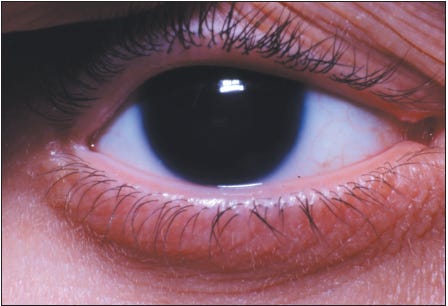
I was intrigued by the umpteenth time I heard this from a victim’s account, or even from reporters interviewing a convicted killer behind bars when he reminisces on his act. Whatever color they once were, the eyes turn dark. As if someone flicked a switch and extinguished the lights.
I needed to know, is this a real thing—scientifically-speaking? I found out fast that going black is not what eyes can do. They don’t change color on demand or according to murderous intent like a mood ring. I had an epiphany the other day that this must be about dilation—the pupils getting bigger in these extreme moments, enough to crowd out the iris with enough black that the eye color seems almost monotone. But why?
At their most rudimentary level, pupils enlarge and decrease (moved by the muscles in the colored surrounding iris) to let in more or less light. They get large in low light so we can see better (like the aperture of a camera lens). In this article on the eye behavior of psychopaths, AllAboutVision describes how pupils also dilate based on brain functions. Pupil enlargement has been linked to moments of increased mental effort (such as when memorizing new information) or when we’re feeling emotions (which sounds vague since who’s not feeling some emotion) or “empathizing with someone else’s.”
One study had participants listen to emotionally neutral sounds, like office noise. The participants then listened to emotionally charged sounds. The sounds portrayed positive emotions (laughter) and negative emotions (crying baby). Participants had their pupil sizes monitored for the duration of the experiment.
Results showed that participants’ pupil size was significantly larger during the emotional sounds. This supports the idea that our pupillary function is linked to our emotions.
So far, this isn’t squaring with the possibility that a psychopath’s eyes might go “dark” since these aren’t people to feel emotion and certainly not empathy. Another study tests the emotional response or lack of response from psychopaths vs. non.
All offenders were shown disturbing images, like threatening dogs or mutilated bodies. Following this, they were shown positive images, such as puppies or people laughing.
Non-psychopathic offenders showed pupillary response to both positive and negative stimuli. This indicated activity in the emotional region of the brain.
Psychopathic offenders had no pupillary response to negative stimuli. Interestingly, they did show pupillary response when exposed to positive images. This suggests that psychopaths may not have an overall immunity to emotion. Rather, they have a specific insensitivity to disturbing stimuli.
So again, this doesn’t explain why—if they are found to be insensitive to disturbing stimuli—their eyes might enlarge in these moments during real crime incidents. (They also say a psychopath has a tendency to avoid eye contact in social settings, so it might be hard to see their eyes to begin with.)
The article finally asks directly, “do serial killers’ eyes really ‘turn black?’” Ted Bundy was formally diagnosed as a psychopath (with the important caveat that not all serial killers are psychopaths and not all psychopaths are serial killers), but the eye thing you may have heard about him too.
Stephen Michaud conducted more than 150 hours of interviews with Bundy. He recalls the way Bundy’s eyes would appear to change color during conversations. As Bundy would open up about his wicked actions, Michaud said his eyes would grow darker and darker.
Perhaps it comes down to chemistry. Or as this article says, “arousal.”
It’s likely that Bundy’s darkened eyes appeared so due to his pupils dilating. This could have happened upon arousal when he was discussing his heinous acts. Further research is needed to determine the biological connection between dilated pupils and alleged arousal in psychopaths.
In an article on “Ted Bundy’s Many Faces: How the Serial Killer Was Able to Change His Appearance So Easily” (and elude authorities for so long) they reference the eye changes that Michaud noted, causing this otherworldly chameleon quality.
According to the author, during his Bundy interviews the killer’s face would physically change with his mood.
It started with his eyes.
“His true day-to-day eye color… He had these kind of pretty blue eyes,” says Michaud. “But when he really got going, his eyes got black.”
Michaud isn’t sure why that is, although he’s open to the idea that it might have had something to do with pupil dilation at times of heightened arousal.
In addition to the blackened eyes, Michaud also says when Bundy would concentrate hard on something, it would cause temporary facial discolorations and swelling.
“This happened three or four times,” he says. “A welt would start crossing his cheek—the right cheek, under his eye... it was so straight. It wasn’t like a scratch. It was white, or light-flesh colored—lighter than his flesh. And then, when he’d relax, it would fade.”
So let’s get down to it. Arousal. This can mean a number of things—fight or flight response, or, as this article claims in ScienceDirect, “The pupils are the windows to sexuality: pupil dilation as a visual cue to others’ sexual interest.”
Artists and philosophers have long contended, “The eyes are the windows to the soul.” The notion that the eyes convey important information about one’s inner state to observers is also backed by scientific evidence. For instance, certain features of the eye—most notably, the pupils—have been shown to change in response to sexual arousal.
Powerful as we are, it’s not as if humans can control what our iris muscles are doing. Bundy might be sharp but he can’t actually determine the involuntary changes in the size of his apertures. There’s a whole field of study called pupillometry—the measurement of pupil size and reactivity to a range of physical and mental processes. A host of chemicals of the autonomic (sympathetic) nervous system can flood us in heightened moments with enough to make the pupils change. The “love drug” oxytocin. The dopamine of pleasure and excitement. Anxiety and stress with its adrenaline and norepinephrine, triggering fight or flight mode (along with increased heart rate, high blood pressure, sweating). Lying! (Another adrenaline moment.) The serotonin of “goal-directed” behavior. Acetylcholine…
Lest I get too deep into the medical journals and the contents of their chemistry cabinets, it’s important to catch my breath in the street vernacular of some perfectly apropos Subreddit, in this case, the one about Serial Killers where multiple people through the years ask exactly my question about the black eyes phenomenon.
Maybe? There is something called the Kubrick stare which is pretty typical of psychosis and mania. It’s not a squint, it’s a widening of the eyes and generally a tilt of the head that comes across unsettling.
I’ve heard of this. Ted Bundy, Richard Ramirez and others were said to have a shift in their physical appearance, demeanor, and even smell. Like a foul odor would suddenly surround them.
Pupils dilate when the sexual appetite and brain are stimulated; this gives the allusion of eyes turning black, especially for dark eyes. Bundy had deep blue eyes. The same would apply to any eyes that had a particular deep/dark colour.
Check out Crazy Not Insane, the doc from HBO. Talks about this.
My best guess is that you’re referring to pupil dilation which can happen when different neurochemicals are released in the body. One instance being adrenaline. Another common example being stimulants.
Robert Keppel actually mentions this in his book The Riverman. They show Ted a crime scene photo of Kathy Devine (as they suspected him in her murder then) and Keppel wrote “Immediately, the contortions of Ted’s face told us that he was morbidly transfixed by the Devine scene. His jaw protruded, and his pupils were hideously dilated. His pulse bulged and radiated through his carotid artery like a huge water bump in a garden hose. I felt suddenly as if he were alone with his thoughts, replaying an internal video of his murder, even with us there.”
Predatory… Like a cat’s eyes do before pouncing.
Like a cat about to pounce. So maybe this eye blackening trick isn’t so specifically human as much as disturbingly revealing of our inner animal.
I eagerly await my next desperate litter of foster kittens for further study.

[Appreciate what I produce here but don’t feel like committing to a paid subscription? Spare some change to Buy Me a Book.]
This is insanely interesting. As you may or may not have known, I researched Bundy as the basis of the character in my second book. I’m endlessly fascinated by the neural and physiological changes in their bodies.
Wow. Not only fascinating but scary. Great piece.