

Chasing Windmills
They might be literary giants

Of all the Ghosts of Christmas Past, Present and Future that haunt Trump (Obamas anyone?), he seems to reserve the greatest terror for windmills. And of all the rabbit holes he loves to spelunk during speeches about other topics, he really gets lost without headlamps in his loathing of the ancient art of wind farming.
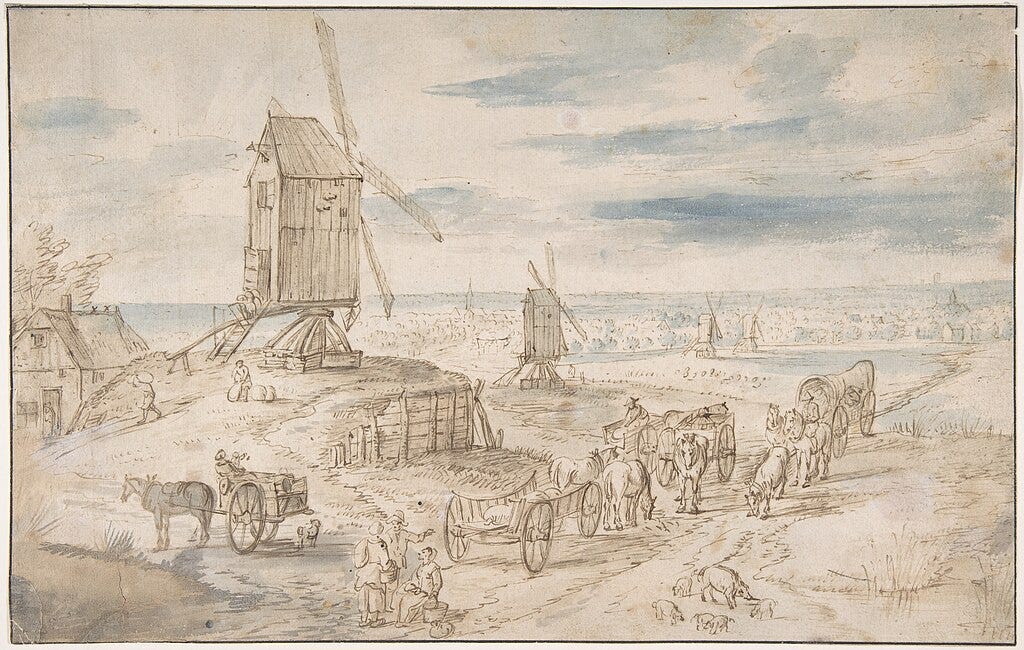
There are innumerable diatribes I could quote on the topic, but here’s one among the most recent, a detour during a meeting with oil executives from early January:
I can proudly say that we have not approved one windmill since I’ve been in office and we’re gonna keep it that way. My goal is to not let any windmill be built; they’re losers. They lose money, they destroy your landscape, they kill your birds, they’re all made in China… They use coal, and they use oil and gas, and some nuclear, not much, but they don’t have windmills. They come and sell them to suckers like Europe and suckers like the United States before. They are the worst form of energy, the most expensive form of energy and in eight years they’re rotted out anyway. Go take a look at Palm Springs, California, and take a look at what that looks like, it looks like a junkyard, a junkyard of steel. So, we don’t approve, and I’ve told my people…we will not approve any windmills in this country.
Pity the poor productive windmill! In New York, our anti-sustainability Prez halted a few major wind farm construction projects that would have helped add desperately needed electricity production to our maxed out grid. Breaking news: I’m thrilled to report they now seem to be back on track, care of court orders to resume work as of early this week. In one project alone, already 45% complete, that’ll be another 600,000 homes powered from offshore wind. Wind and solar are real low-hanging fruit in the energy game, if you ask me, but according to our literary canon chasing windmills has a tradition of being bound up with lunacy.
Windmills have been getting a bad rap since Miguel de Cervantes’s epic episodic quest of Don Quixote launched what is considered the modern novel in the early 1600s.
This famous Quixote excerpt puts windmills on the map as the folly of fanatics, which later leads to the 1971 movie adaption They Might be Giants, inspiring the self-same band name. “Quixotic” even becomes its own word—surely a dream for any author—meaning “exceedingly idealistic, unrealistic, impractical.”
“Just then, they discovered thirty or forty windmills in that plain. And as soon as don Quixote saw them, he said to his squire: “Fortune is guiding our affairs better than we could have ever hoped. Look over there, Sancho Panza, my friend, where there are thirty or more monstrous giants with whom I plan to do battle and take all their lives, and with their spoils we’ll start to get rich. This is righteous warfare, and it’s a great service to God to rid the earth of such a wicked seed.”
“What giants?” said Sancho Panza.
“Those that you see over there,” responded his master, “with the long arms—some of them almost two leagues long.”
“Look, your grace,” responded Sancho, “what you see over there aren’t giants—they’re windmills; and what seems to be arms are the sails that rotate the millstone when they’re turned by the wind.”
“It seems to me,” responded don Quixote, “that you aren’t well-versed in adventures—they are giants; and if you’re afraid, get away from here and start praying while I go into fierce and unequal battle with them.”
And saying this, he spurred his horse Rocinante without heeding what his squire Sancho was shouting to him, that he was attacking windmills and not giants. But he was so certain they were giants that he paid no attention to his squire Sancho’s shouts, nor did he see what they were, even though he was very close. Rather, he went on shouting: “Do not flee, cowards and vile creatures, for it’s just one knight attacking you!”
At this point, the wind increased a bit and the large sails began to move, which don Quixote observed and said: “Even though you wave more arms than Briaræus, you’ll have to answer to me.”
When he said this—and commending himself with all his heart to his lady Dulcinea, asking her to aid him in that peril, well-covered by his shield, with his lance on the lance rest —he attacked at Rocinante’s full gallop and assailed the first windmill he came to. He gave a thrust into the sail with his lance just as a rush of air accelerated it with such fury that it broke the lance to bits, taking the horse and knight with it, and tossed him rolling onto the ground, very battered.
Sancho went as fast as his donkey could take him to help his master, and when he got there, he saw that don Quixote couldn’t stir—such was the result of Rocinante’s landing on top of him. “God help us,” said Sancho. “Didn’t I tell you to watch what you were doing; that they were just windmills, and that only a person who had windmills in his head could fail to realize it?”
“Keep still, Sancho, my friend,” responded don Quixote. “Things associated with war, more than others, are subject to continual change. Moreover, I believe—and it’s true—that the sage Frestón—he who robbed me of my library—has changed these giants into windmills to take away the glory of my having conquered them, such is the enmity he bears me. But in the long run, his evil cunning will have little power over the might of my sword.”
“God’s will be done,” responded Sancho Panza.”
Fast forward hundreds of years to another ever enduring classic that I felt compelled to read in recent months when Trump called a reporter “Piggy” and I sought solace in the good pigs of literature like Charlotte’s Web and Animal Farm. Only, Animal Farm’s pigs take a turn into authoritarianism when they oust their human leaders and morph into something much worse. The surprising sleeper character of the dystopian farm fable is actually none other than the recurring windmill.
From George Orwell’s hit of 1945, which you can read online here, here’s a whole host of quotes below on the pigs’ very stubborn and Sisyphean quest to build a windmill, at all costs. Under the clumsy mis-management of a pig duo that includes practical Snowball and megalomaniacal Napoleon, the first iteration gets destroyed as soon as they finish, and then the second, until finally after many years of grueling deadly effort they achieve a third.
Napoleon produced no schemes of his own, but said quietly that Snowball’s would come to nothing, and seemed to be biding his time. But of all their controversies, none was so bitter as the one that took place over the windmill.
After surveying the ground, Snowball declared that this was just the place for a windmill, which could be made to operate a dynamo and supply the farm with electrical power. This would light the stalls and warm them in winter, and would also run a circular saw, a chaff-cutter, a mangel-slicer, and an electric milking machine. The animals had never heard of anything of this kind before (for the farm was an old-fashioned one and had only the most primitive machinery), and they listened in astonishment while Snowball conjured up pictures of fantastic machines which would do their work for them while they grazed at their ease in the fields or improved their minds with reading and conversation.
At this Snowball sprang to his feet, and shouting down the sheep, who had begun bleating again, broke into a passionate appeal in favour of the windmill. Until now the animals had been about equally divided in their sympathies, but in a moment Snowball's eloquence had carried them away. In glowing sentences he painted a picture of Animal Farm as it might be when sordid labour was lifted from the animals’ backs. His imagination had now run far beyond chaff-cutters and turnip-slicers. Electricity, he said, could operate threshing machines, ploughs, harrows, rollers, and reapers and binders, besides supplying every stall with its own electric light, hot and cold water, and an electric heater. By the time he had finished speaking, there was no doubt as to which way the vote would go.
Seeing as they are only animals, this labor was absurdly challenging.
The windmill presented unexpected difficulties. There was a good quarry of limestone on the farm, and plenty of sand and cement had been found in one of the outhouses, so that all the materials for building were at hand. But the problem the animals could not at first solve was how to break up the stone into pieces of suitable size. There seemed no way of doing this except with picks and crowbars, which no animal could use, because no animal could stand on his hind legs. Only after weeks of vain effort did the right idea occur to somebody—namely, to utilise the force of gravity.
The hens woke up squawking with terror because they had all dreamed simultaneously of hearing a gun go off in the distance. In the morning the animals came out of their stalls to find that the flagstaff had been blown down and an elm tree at the foot of the orchard had been plucked up like a radish. They had just noticed this when a cry of despair broke from every animal’s throat. A terrible sight had met their eyes. The windmill was in ruins.
They blame Snowball instead of the storm, a real scapegoat of a pig. Onto the painful second attempt, would have to be much sturdier, no less than three feet wide (which reminds me of the impossibly impressive stone walls of Sleepy Hollow’s own Old Dutch Church, built by the enslaved of course though the plantation owner Philipse takes credit on the plaque to this day).
Still, it had been decided to build the walls three feet thick this time instead of eighteen inches as before, which meant collecting much larger quantities of stone.
In the autumn, by a tremendous, exhausting effort-for the harvest had to be gathered at almost the same time—the windmill was finished. The machinery had still to be installed, and Whymper was negotiating the purchase of it, but the structure was completed. In the teeth of every difficulty, in spite of inexperience, of primitive implements, of bad luck and of Snowball’s treachery, the work had been finished punctually to the very day! Tired out but proud, the animals walked round and round their masterpiece, which appeared even more beautiful in their eyes than when it had been built the first time. Moreover, the walls were twice as thick as before. Nothing short of explosives would lay them low this time! And when they thought of how they had laboured, what discouragements they had overcome, and the enormous difference that would be made in their lives when the sails were turning and the dynamos running—when they thought of all this, their tiredness forsook them and they gambolled round and round the windmill, uttering cries of triumph.
And then just that: a heart-breaking explosion.
Terrified, the animals waited. It was impossible now to venture out of the shelter of the buildings. After a few minutes the men were seen to be running in all directions. Then there was a deafening roar. The pigeons swirled into the air, and all the animals, except Napoleon, flung themselves flat on their bellies and hid their faces. When they got up again, a huge cloud of black smoke was hanging where the windmill had been. Slowly the breeze drifted it away. The windmill had ceased to exist!
“What matter? We will build another windmill. We will build six windmills if we feel like it.”
“It is my lung,” said Boxer in a weak voice. “It does not matter. I think you will be able to finish the windmill without me. There is a pretty good store of stone accumulated. I had only another month to go in any case.”
Against all odds and the life of horse Boxer, they do it, a third windmill. What astounding grit (madness?) to keep going and going and going. Finally, it works, but not quite as intended:
The farm was more prosperous now, and better organised: it had even been enlarged by two fields which had been bought from Mr. Pilkington. The windmill had been successfully completed at last, and the farm possessed a threshing machine and a hay elevator of its own, and various new buildings had been added to it. Whymper had bought himself a dogcart. The windmill, however, had not after all been used for generating electrical power. It was used for milling corn, and brought in a handsome money profit. The animals were hard at work building yet another windmill; when that one was finished, so it was said, the dynamos would be installed. But the luxuries of which Snowball had once taught the animals to dream, the stalls with electric light and hot and cold water, and the three-day week, were no longer talked about. Napoleon had denounced such ideas as contrary to the spirit of Animalism. The truest happiness, he said, lay in working hard and living frugally.
The exciting elusive thing they chased was not what they received. Turns out the hard working animals’ dream of light and economic liberty brought them instead to more poverty and toil when the plot is twisted under corrupt and anti-visionary leadership. The animals would continue to labor with no rewards while their bosses alone would benefit. The hard-won windmill would not produce unbridled power as hoped but just dutifully grind grain, obeying the mission of keeping the workers small, tied to the ground, bound. Snowball with his bold ideas of a different democratic, sustainable world has been ousted, sacrificed. The remaining pigs (bloated Napoleans all) weirdly walk around upright on two legs now, drinking, gambling, bickering with the ugly humans they once reviled and revolted against.
They could have been giants.
[Appreciate what I produce here but don’t feel like committing to a paid subscription? Spare some change to Buy Me a Book.]
Apologies if you read an early version of this where my human folly was being unable to spell windmills. Windwills also have a nice ring to them!
Thanks, Krista, for reminding me of the windmill allegory in Animal Farm. As modern power-generating windmills are close to my heart, I am hoping that we get back on track to tap this endless (and increasingly strong, as witnessed by our weather predictions for today) source of fuel-free energy. Wind and solar are economically a much better means of powering our energy future as fossil fuels become more and more expensive to extract. New, power-hungry projects like data centers MUST be constrained to use their own new renewably-produced onsite energy sources, not carbon-based grid power. (BESS can help: https://events.ticketleap.com/tickets/teatown/battery-energy-storage-systems )