


I love Sleepy Hollow so much it has become my brand; my haunted perch along the Hudson seeps into my identity. Also, because of who I am is why I was attracted to this place in the first place, so Sleepy Hollow mirrors me too.
Sleepy Hollow, New York, I mean. The real one! Do I really have to specify? The one named after fiction which was inspired by a real place. Sleepy Hollow was loosely a region of farmland unofficially on the map when Washington Irving in the late 1700s visited the lower Hudson Valley as a teen, avoiding the deadly yellow fever epidemic of NYC for a trip to Tarrytown and its environs. Later from England he wrote The Legend of Sleepy Hollow, a name we only formally acquired in 1996 to help us fill the void of the General Motors car plant shuttering.
But perhaps we’re not so special. Turns out, there are other Sleepy Hollows all over the place, and weirdly some of them have Headless Horsemen mascots attached, as if they think the Old Dutch Church and Ichabod’s escape route exist in the middle of wherever they are. It’s confusing!
So much so, that a guy wrote to me on my Facebook page and said, “that’s a real place? I thought you were kidding.”
No indeed sir, the place and its contents are 100% real. But I don’t know about this other stuff:
A quick internet search, alongside my own life travels, and the wanderings of an equally obsessive J.W. Ocker reveal: Many other locations named Sleepy Hollow are fixated on the Headless Horseman.
Even AI notes that these other SHs can lay no claim to the history or the geography while nonetheless grabbing at the famous name:
Most of these other locations are small residential neighborhoods, unincorporated communities, or tiny subdivisions that adopted the cozy, scenic name. None carry the literary history or the Headless Horseman folklore of the original Sleepy Hollow, New York.
But here’s a travelogue if you care to check all these (lesser) Sleepy Hollows off your list, which I do think would be a unique way to thematically travel the country.
California: “Sleepy Hollow exists at the north-west corner of San Anselmo, set in a wide valley surrounded by grassy, tree studded hills. About 750 homes were built starting in the 1950’s, most on a third to half an acre—with many lots over an acre. The typical, original Sleepy Hollow home is a California ranch-style, 2,000-3,000 sq. ft., with a pool. This is ideal horse riding country, and some properties have their own stable. The main street into this community is Butterfield Road. Many of the neighborhood streets are named after characters and places in Washington Irving’s Rip Van Winkle and the Legend of Sleepy Hollow.” (Property values? Available listings at this realtor’s website are priced in the millions.)
Illinois: Has a village located in Kane County. The official website of the village is an absurd (very badly designed) version of the headless horseman logo with lanky arms that look more like awkward Ichabod, who does not generally run around headless. It all began as a farm named Sleepy Hollow bought by an Italian immigrant named Floyd Falese in 1953, who started marketing the land as a subdivision called Sleepy Hollow Manor, eventually becoming incorporated in 1958. “To retain the rural charm and natural contour of the location, Falese retained the services of a prominent planner and landscape architect, Raymond W. Hazekamp, who laid out a pattern of meandering roads, without curbs or sidewalks, that wound into curvilinear cul-de-sacs, avoiding the destruction of a single tree. In addition, spring-fed lakes were dredged and stocked with fish, and Scholz-designed homes were constructed on lots of at least half an acre, the designs carefully selected to enhance what Falese called ‘the Sleepy Hollow concept of good living.’”
The website About Us section continues: “There is no business or industry in Sleepy Hollow. It is strictly a residential community, and, except for a handful of municipal employees, all of its workers are, therefore, commuters. Some residents say this has resulted in a curious lack of communal focus as there is no Main Street where the townspeople can meet and mingle as fellow citizens. But there has been a group of citizens who from 1961 to 1983 published a lively newsletter, keeping citizens abreast of social and civic functions in the community. And in 1973 a very active Sleepy Hollow Men’s Service Club was organized. It has sponsored a variety of programs, including Fourth of July celebrations, spring dances, halloween parades and bonfires after which the Headless Horseman rides through the village, Easter egg hunts, Octoberfests, and teen dances. The popular Fourth of July celebration is a day-long family celebration. Beginning in the morning with a fishing derby, it includes numerous games, contests, food, a parade, and a revue by the Imperial Scots. The evening fireworks display is well-known, attracting many people from the surrounding communities. In addition, parents find a common interest in the Sleepy Hollow Elementary School. In the summer friends meet around the swimming pool, a common gathering place.”
I was fascinated enough to reach out to their “Village President” Courtney Boe, whose email is listed on the village website, so we’ll see what she says in defense of their logo and their good living.
Indiana: Clinton County’s Sleepy Hollow is located on a lonely road near a bridge spanning the South Fork of the Wildcat Creek, and according to America’s Haunted Road Trip, “Indiana has its own Sleepy Hollow located just outside of Frankfort, and it, too, has a haunting tale. You won’t encounter a headless horseman, but what they say you’ll find there is much more frightening.”
Legend has it that a farmer’s wife in the 1800s, after serving dinner, lost it for whatever reason and killed her husband? Was he a jerk? Did she use a skillet? No one knows.
“To cover up the crime and dispose of the evidence – the body – she decided to cut him up into manageable pieces. Once this was achieved, she waited until it was dark. Then she loaded him onto the wagon and proceeded to Wildcat Creek bridge. Once there she began to toss him, piece by piece, over the bridge and into the creek. Later, she became fearful that someone would find the pieces. Night after night she went to the bridge to make sure there was nothing to be found. Even if she wasn’t out of her mind when she killer her husband, her guilt most certainly drove her insane. In fact, even after her death, she still protects her secret. Many have said that on this lonely road as you approach the bridge, she’ll appear as a light floating toward you in an attempt to scare you away. But if you’re really “lucky,” according to some stories you might encounter her husband rising from the creek – piece by piece.”Georgia: Sleepy Hollow Farm is on Sleepy Hollow Road, in Powder Springs. They sell Christmas Trees, but this time of year, it’s Fall Fest: “This fall bring your whole family out to Sleepy Hollow Farm for some fresh air and fall fun. During the daytime take a tractor ride with your family or friends around our farm, explore our corn maze, and then pick out your perfect pumpkins to add to your decorations inside and out. To get to our pumpkin patch you will need to purchase general admission tickets. We also have different fun kids games in our farm playground and farm animals.”
Maryland: A campground in Grantsville in the Appalachian Mountains.
Michigan: Sleepy Hollow refers to both Sleepy Hollow State Park (Laingsburg, surrounding Lake Ovid) and the Sleepy Hollow Beach Resort of South Haven on Lake Michigan.
From the camp’s Hipcamp’s listing:
“No need to worry about ghosts here—Sleepy Hollow Campground is nothing like the legend. Explore the expansive 2,600 acres of woodlands, winding rivers, and trails by horse or foot. Electrical service in these cabins mean you don't have to worry about bringing those extra flashlight batteries. We have heard some stories about a headless horseman, but no need to worry...they’re probably just rumors, right?” Too bad.Mississippi: An RV park in Laurel.
Virginia: A Sleepy neighborhood in Fairfax County, just 10 minutes from DC, where nothing ever goes wrong.
Wyoming: A “census-designated place” in Campbell County, which makes it to Odd Things I’ve Seen, a blog by J.W. Ocker:
“I was prepped for roads named after characters from the Washington Irving story. I was prepped that the town welcome sign resembles a covered bridge (which was not in the original story, but sagely added later in by Disney). I was even prepped for its five-story water tower with a gorgeous orange, yellow, and black harvest scene that isn’t really Sleepy Hollow-themed unless you count the scarecrow in it that resembles one used in Tim Burton’s Sleepy Hollow film. Either way, it works perfectly in a place called Sleepy Hollow.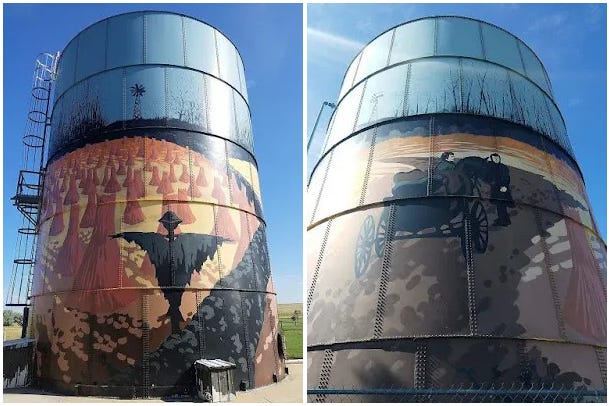
By J.W. Ocker “All of those sites are within a hundred feet of each other, the Water Tower at the end of Brom Street, just around the corner from the welcome sign. What I wasn’t prepared for, though, was a 100-foot-tall mural of the galloping goblin himself.”
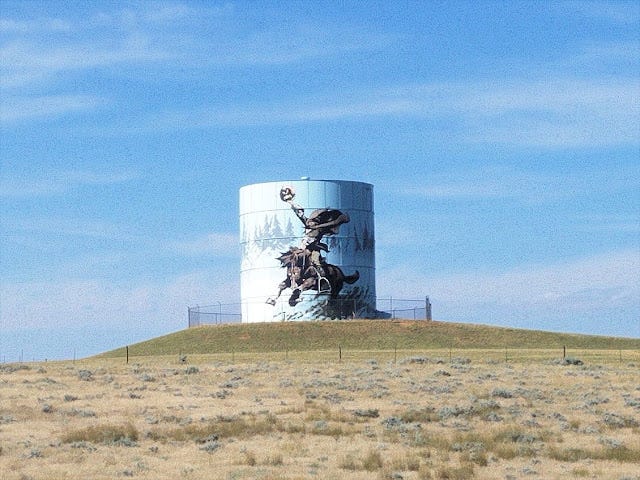
Headless water tower, J.W. Ocker captured from a distance “And then you see it.
A Halloween harbinger.
A giant one.
He’s dressed in black astride a matching black steed. He has no head, but in his upraised hand is a fiery orange jack-o-lantern, aimed squarely at your car. Then you realize that the blue behind him doesn’t quite match the blue on the sprawling canvas of sky surrounding you.. The Headless Horseman is on a massive water tower.
But I’m jazzed to know that it’s there. I hope herds of cattle or buffalo wander in front of it every once in a while. On my death bed, I will make sure I live one more hour just to reminisce about it. Sleepy Hollow, New York, doesn’t have anything close to this monumental a monument.”

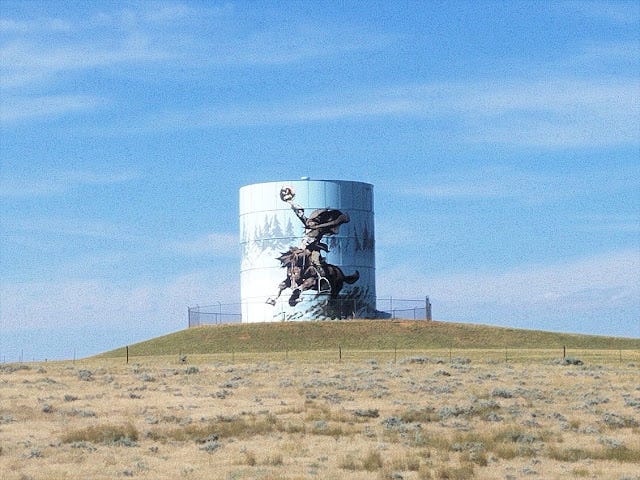
Well, hey now, I beg to differ. We have a rusty metal sculpture of our headless dude cast in layers in a parklet triangle, but admittedly he does lack this scale. I also wanted to pick their Wyoming brains about their water tower headless rendition, but lacking any government administrators (they aren’t incorporated), I wrote to the head of the Sleepy Hollow Homeowners Association. We will see if either of my kind but curious epistles get return-mail.
The travel list goes on with various unincorporated areas, roads, farms, campsites. Everyone lays claim to Sleepy Hollow, and why not.
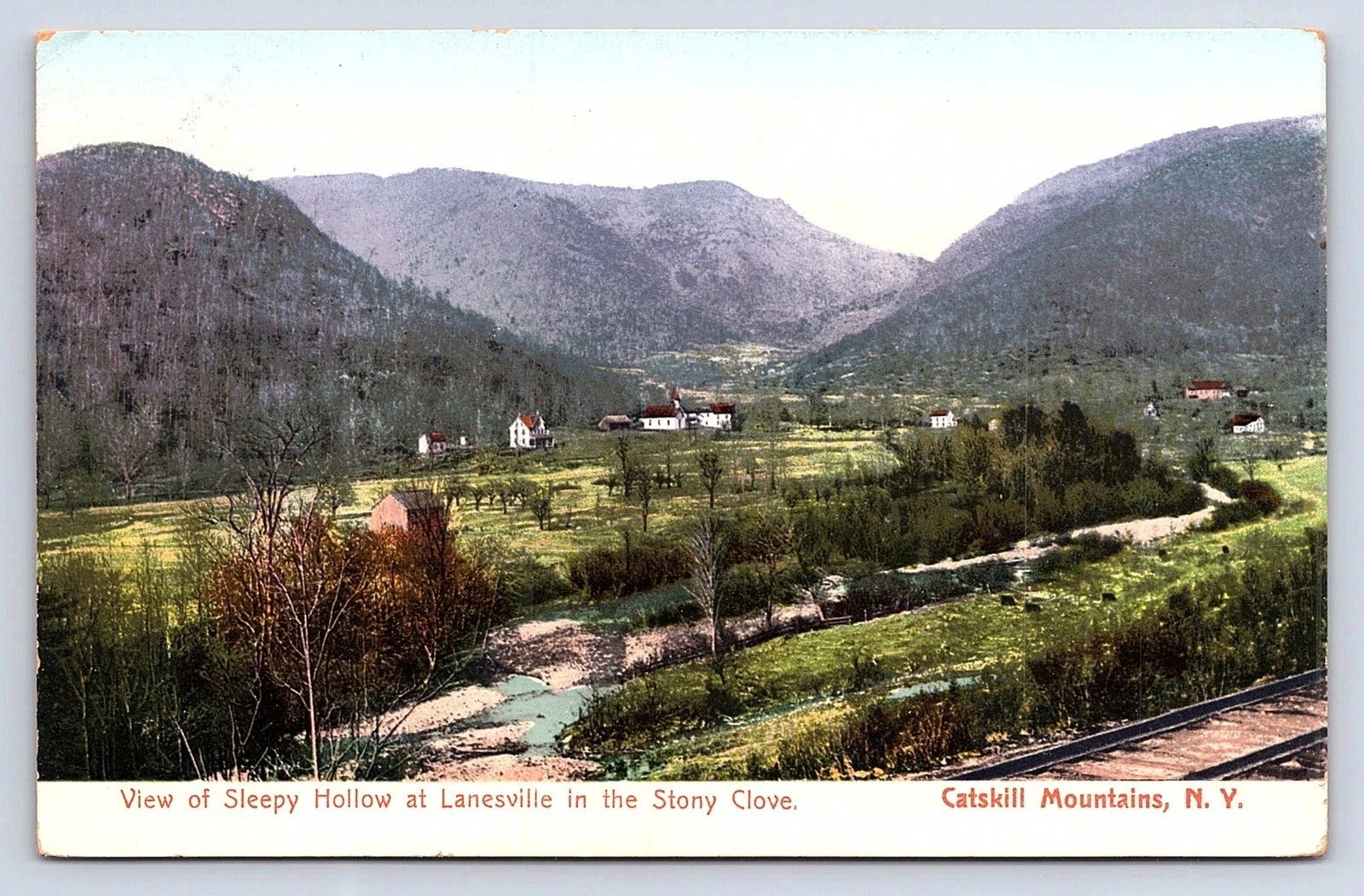
In my own travels, I just discovered this summer that Iowa has a Sleepy Hollow Scream Park in Des Moine. Even New York State can’t just settle on one SH. Route 28 in the Catskills has a Sleepy Hollow Campground I pass by often on my weekends upstate, and by coincidence, the sweet pocket of land I used to own up there apparently overlooked a Sleepy Hollow valley I didn’t know existed.
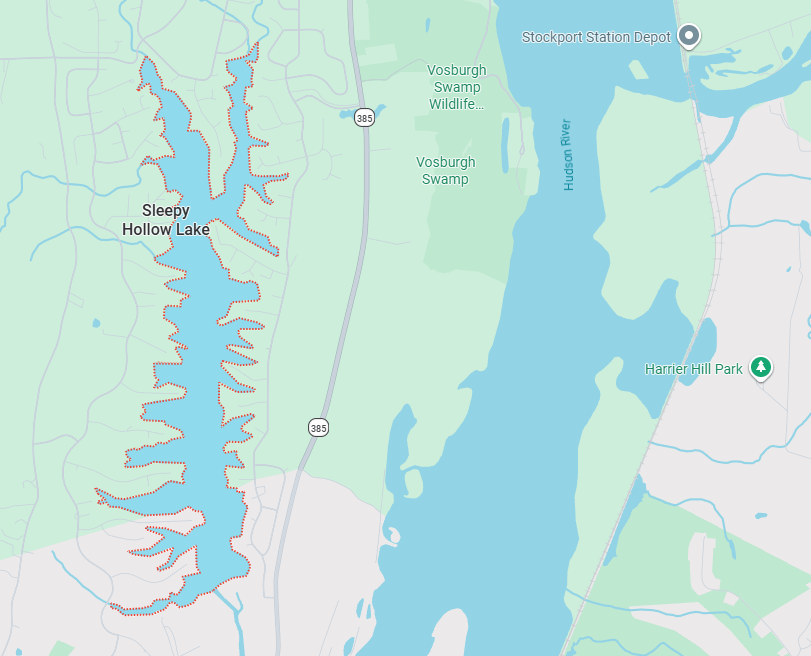
A little more upriver there’s Lake Sleepy Hollow between Athens and Coxsackie with a really insane outline you can have a field day with if you’re playing Rorschach.
Why so many? Here’s a theory embraced by J.W. Ocker, who, by the way, after his travels to Other Sleepy Hollows, has a new book out now about the real deal with a book signing and panel event coming up on 10/10 at our own Tarrytown Music Hall.
Here’s an interesting twist. At the end of Washington Irving’s story, we learn that, if you believe the rumors, Ichabod Crane didn’t disappear into hellfire, but fled New York for “a distant part of the country.” Maybe as distant as Illinois. Maybe as distant as Wyoming. Probably not as distant as Hawaii.
That would make him the Johnny Appleseed of ghost stories. And would further emphasize the fundamental truth that you can’t outrace the Headless Horseman.
I suppose we will keep chasing.
[Appreciate what I produce here but don’t feel like committing to a paid subscription? Spare some change to Buy Me a Book.]
Hmm, I was going to say that maybe the "spirit" of Sleepy Hollow, by its nature, wanders, though clearly the wellspring is where you reside. But it turns out the Legend itself gives us an answer. Very glad you've found a home, btw. As a total aside, yellow fever really plays into the history of Memphis too.