

Oral
The precision and 'wild extravagance' of giving good speech

THE EXEMPLARS
When Heather Cox Richardson, American historian/professor/writer, says she heard some stellar oratory, I believe her and go give a listen. Granted I’m living under a bit of a rock where I hadn’t heard NYC Mayor Mamdani’s energetic victory lap of a speech for the recent Knicks’ ticker tape parade day, but at least I got there eventually care of HCR.
It is quite a speech—caught in full here—full of joy and specific storytelling:
And just before that, I got to hear both Mr. and Mrs. Obama giving grand oratory surrounding the launch of Chicago’s Obama Presidential Center, in two inspiring clips below. Oh how we miss this man.
And Michelle demonstrating her matrimonial love like no other. The “awe” she says she feels every day for her spouse.
All three of these graceful and moving orations remind us that words matter, but also very importantly are rooted in love, for a certain place and its people. I was writing in recent weeks about this sort of specificity of local/loco with Sleepy Hollow, my chosen home. How the self merges with the surroundings, if you let it and live fully.
The Obama Center couldn’t be anywhere but Chicago, they both said. The Knicks are a true fable about the grit of New York, 53 years of our “sick suffering hearts,” says Mamdani. And finally, when faced with a 99.6 percent chance of failure, taking it as a challenge and “in that .4% we go to work.”
One writer took the time to praise all three speeches—which happened to fall in short succession in a few thrilling days—in the essay, Obama and Mamdani Show How It’s Done:
This week, we saw two distinct visions of what it means to honor and celebrate the United States.
The first is the one you know, the Ultimate Fighting Championship spectacle in Washington, where President Trump presided over pyrotechnics, blood sport and general mayhem. Ostensibly planned to mark the 250th anniversary of the nation—which, as we all know, was founded by a cadre of mixed martial artists and podcasters—it was in reality a birthday celebration for a president who sees himself as the embodiment of the nation or who, at least, is unable to step out of the spotlight for even a moment.
Billed as though it was for the American people as a whole, the U.F.C. event was not, in truth, for the public; it was for Trump and his most dedicated supporters. With its aggressive machismo and shock-jock sensibility, it was designed to exclude all but the MAGA faithful—and even then, only those who subscribed to Paramount+.
The opening of the Obama Presidential Center in Chicago was not technically an event to mark the 250th anniversary of the Declaration of Independence. And yet it had the tone and tenor of a more traditional celebration. There were popular celebrity musicians—Stevie Wonder, John Legend, Bruce Springsteen and the Roots, among others—to perform for the crowds. And our living ex-presidents—George W. Bush, Bill Clinton and Joe Biden—sat in attendance as Barack Obama introduced the center and offered a few words of reflection.
“The exhibits here focus not just on policies, but on the shared values that make democracy possible,” Obama said. “A belief in the intrinsic dignity and worth of all people, and that no one is above the law or beneath its protection. A belief in checks and balances in our government and an accountability that comes with it, an independent judiciary and a robust free press.” And a belief, he continued, “that qualities of character, honesty, integrity, kindness, compassion, a sense of duty and honor, those things matter in our public dealings, just as they do in our private lives.” These values, Obama concluded, are “our greatest inheritance.”
In the same week, the Knicks’ victory and the most energetic, jubilant speech from a youthful, idealistic mayor (who also gets stuff done):
“Over these past weeks, as the Knicks kept winning, our city has come together as one,” Mamdani said. “Neighbors invited neighbors over. Strangers high-fived one another in the street. Subway conductors sang their announcements and bus drivers danced behind the wheel. So often when this city comes together, it is because we are forced to, by a moment of tragedy or adversity. What a gift it is to be brought together by pure, unfiltered joy. For as long as we live, we will remember this feeling of a city together, a city alive, a city overcome by happiness.”
In the absence of a White House administration that values the cosmopolitan and egalitarian aspirations of American democracy, we have these moments that speak beyond the specific circumstances of a professional basketball team or a library to the country at large. It is both a heartening reminder that we have not, as a public, abandoned our highest values, and a sad commentary on the political leaders who have, if they ever believed in them in the first place.
THE ELEMENTS OF STYLE
What makes for great oratory? I’m sure HCR would mention the British Prime Minister who served during WWII, Sir Winston Churchill, as among the finest in history—alongside Lincoln. “So gifted was Churchill that he was awarded the Nobel Prize for Literature in 1953 for ‘mastery of historical and biographical description as well as for brilliant oratory in defending exalted human values,” states an article on his legendary ability. Churchill himself, who didn’t just happen upon the art but studied it, once wrote a guide to help future speechmakers.
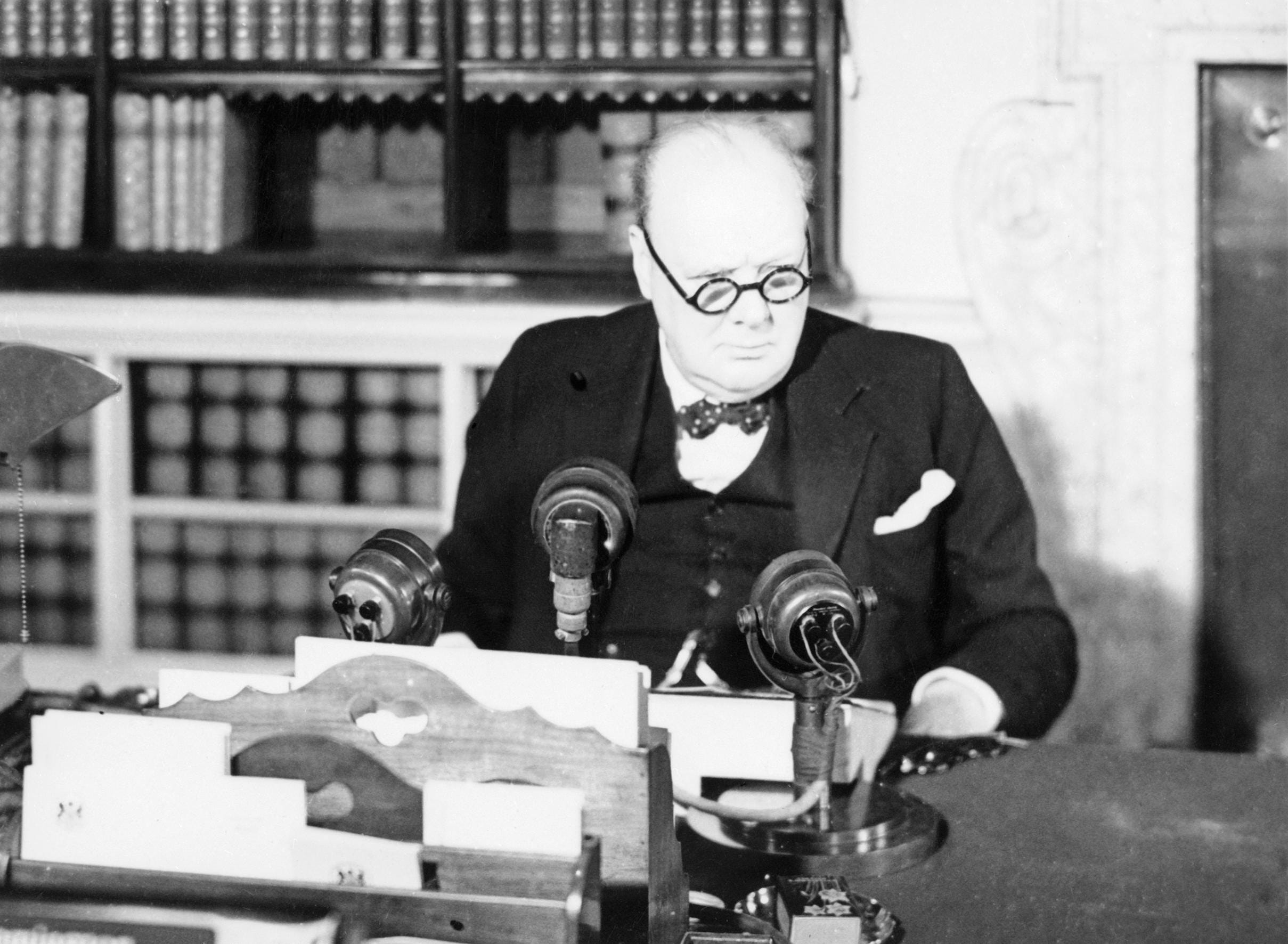
Churchill wrote:
It appears there are certain features common to all the finest speeches in the English language…rhetorical power is neither wholly bestowed nor wholly acquired, but cultivated. The peculiar temperament and talents of the orator must be his by nature, their development is encouraged by practice. The orator is real. The rhetoric is partly artificial…The orator is the embodiment of the passions of the multitude…Before he can draw their tears, his own must flow. To convince them he must himself believe. He may be often inconsistent. He is never consciously insincere.
Long before politics and wars (and winning them), Churchill was a writer and wrote an essay (unpublished) called “The Scaffolding of Rhetoric” in 1897. Here he broke down the craft into five points he borrowed from Greek classics, Shakespeare, Lincoln and others.
Precision - The ‘exact appreciation of words’ which includes ‘the continual employment of the best possible word.’ Churchill’s advice was to use ‘short, homely words of common usage.’ These words needed to be understandable, but the sentences didn’t need to be short. Ideally, they would have an ‘internal rhythm.’
Tempo and rhythm. The ‘influence of sound on the human brain’ Churchill believed, was most impactful when ‘the sentences of the orator… become long, rolling and sonorous’. Great orators are able to express their words in blank verse— as opposed to regular prose. Shakespeare was his life-long influence when emulating this type of blank verse.
Accumulation of argument. In Churchill’s words, ‘a series of facts is brought forward all pointing in a common direction… the crowd anticipate the conclusion and the last words fall amid a thunder of assent.’
Analogy. An apt analogy connects or appears to connect distant spheres of abstract thought. It appeals to the everyday knowledge of the listener and invites them to imagine. Churchill asserts that analogies ‘translate an established truth into simple language’.
Wild Extravagance. My personal favorite. Churchill said that ‘the emotions of the speaker and listeners are alike aroused and some expression must be found that will represent all they are feeling’.
You can see all of this at work in our contemporary masters—the repetition, the rhythm, the “wild extravagance” paired somehow with precision. It’s all about juxtaposition and contrast: the colloquial alternating with flourishes of poetry and deep feeling. Complex but relatable ideas well-told. These notable words that are meant to feel off-the-cuff but come rehearsed, practiced (and never too much). Their ultimate sincerity.
Who is a contemporary or historic speaker you admire? What techniques do they employ to inspire our awe and activate our hearts? Are good speakers, like Flannery O’Connor once said about a good man, increasingly hard to find?
Really enjoyed this. Also thinking back to what Mamdani said about NYC coming together via tragedy or adversity and how much sorrowful, generous love there was in the city after 9/11. I don't know if I ever felt I "belonged" to that degree anywhere before or after. (I wrote an essay touching on this, including my beloved little parrot who became concerned over the intensity [and volume] of my weeping - they do keep an eye on you.) I was really rooting for the Knicks and wished I could have been there. (Did not want to be there for Covid, however.)