

Echolalia
Motherless Part 2

Gobsmacked and rendered somewhat speechless over the website Motherless.com and the recent reveal of one corner of its contents where men share tips and tricks on drugging and raping their wives, I turned to another writer on the subject, Elayne Kalila, with her great piece “What Happens When the World is Motherless.” Now, some months later, I thought it would be amusing/elucidating to explore this “motherless” topic through the lens of Motherless Brooklyn by Jonathan Lethem (1999).
This is the most literary of hard-boiled detective novels because the main character, Lionel Essrog, has Tourette’s syndrome and emits language all day in irreverent outbursts, odd creations, and non sequitur manglings that convert the whole landscape of urban grit into a surprisingly tantalizing word salad. What raw truths would I find there about the state of gender in our times?
I knew this was a man’s world I was entering but that there must also necessarily be (as there always are) some side-piece females far more significant than they may at first appear. The very fact of calling this book Motherless Brooklyn calls attention to the centrifugal-force founding female part, the haunting of absence that becomes one of the most important themes. So I was on the lookout for mothers in particular, and women in general, in a book rife with hyper-masculine car chases and stake-outs and dumpster murders.
The gang of misfit teens who once get taken in by Frank Minna, their shady mob sort of father figure, come straight from an orphanage. Frank grooms these wayward high school boys into whatever he needs them to be, adopting them as his minions by sprinkling them with $20 bills. Before this, Lionel “grew up in the library of the St. Vincent’s Home for Boys,” in downtown Brooklyn, where he read every book and tried to control/fathom what came out of his mouth. With Frank, he settles into himself a bit. The uncontrollable tick becomes a trademark that Frank is fond of, perhaps as a great leveling agent to throw people off the scent of whatever crap he’s up to.
Women, though fringe, always loomed large in their boyhood imaginations. In the Home for Boys, they watched a ton of TV…
to study the antics of the women—women! exotic as letters, as phone calls, as forests, all things we orphans were denied—and the coping of their husbands, but I didn’t find myself there, Desi Arnaz and Dick York and Larry Hagman, those harried earthbound astronauts, weren’t showing me what I needed to see, weren’t helping me find the language.
It was Minna who brought me the language, Minna and Court Street that let me speak.
In this man’s world mix, it is a girlish though somewhat gender-neutral woman who starts and ends the story—who turns out to be named “Kimmery”—with “short hair, squarish glasses, that was all I saw before her back was to us. She wore a pea coat. Sworls of black hair at her neck, under the boyish haircut. Twenty-five maybe, or maybe eighteen.” Essrog discovers her going into the Buddhist “Zendo” where the minions are on a stake-out for reasons unknown.
Lionel’s the most obvious token freak among the orphan gang. At one point, they visit the house of the two men Matricardi and Rockaforte, who seem trapped in time in their mom’s old parlor. “Exactly as she kept it, we never changed a thing,” says Matricardi, next to his friend, two old men seated in plush chairs in brown suits. And later, “Everything exactly as she kept it, she would see it and know. If she were here, bless her sweet pathetic soul.” (Note the “Matri” right there in his name since he can’t let her ghost go.) The parlor is festooned with golf leaf on the ceiling’s plaster scrollwork, a super-sized grandfather clock, vases with flowers, ancient carpet layered with color, walls covered with family photographs. It’s a shrine to their matriarch as if she’s the altarpiece of their church.
A dream map of the past,
It was more like a museum diorama of Old Brooklyn than a contemporary room.
Then the boy squad has the benefit of meeting of Minna’s mom, referred to by her doting son with affection as the “Old Stove.” Carlotta Minna, a ceaseless cook who churns out food that she sells to neighbors by word of mouth and quality of her reputation.
She truly worked an old stove, too, a tiny enamel four-burner crusted with ancient sauces and on which three or four pots invariably bubbled. The oven of this herculean appliance was never cool; the whole kitchen glowed with heat like a kiln. Mrs. Minna herself seemed to have been baked, her whole face dark and furrowed like the edges of an overdone calzone.
Frank doesn’t stop time and preserve a mom-shrine the way the two old Matri guys do. The minute the poor Old Stove dies, in comes a replacement in the form of Frank’s hot new wife. Julia emerges when he disappears between the end of what started as a shady moving company and the beginning of a pretty inept detective agency. The boys of course take notice. An original woman to replace the primary original woman.
She might have been the last and greatest of the Minna girls, for all we knew—she sure looked the part: tall, plush, blond by nurture, defiant around the jaw…
If Julia and Frank had still been animated, quickened with love, we might have remained in infantile awe of her, our fascination and lust still adolescent. But the chill between them was an opening. In our imaginations we became Frank and loved her, unchilled her, grew to manhood in her arms. If we were angry or disappointed with Frank Minna we felt connected to his beautiful, angry, disappointed wife, and we were thrilled. She became an idol of disillusionment. Frank had shown us what girls were, and now he’d shown us a woman. And by failing to love her, he’d left a margin for our love to grow.
You were the original woman, I wanted to tell her… We had watched women and letters soar past before, but you were the first that was addressed to us, and we tried to understand you. And we loved you.
When Kimmery enters the scene (or rather gets noticed in a scene and becomes a player through just happening to be somewhere and open to conversation), she seems to break the two classic female prototypes available to us of Madonna/Whore (stove mom/sexpot wife). It almost feels possible from their brief budding relationship that Lionel could find real, deeper companionship since she is quietly and refreshingly complicated. Age uncertain, gender a little fuzzy. She’s not caricature-female with boobs and lips and sass (or a sauce-stained kitchen) but instead exhibits: the Buddha nature of a gentle soul, tender, empathetic, a good listener. In Kimmery’s presence, Lionel feels safe enough to let the words rip freely.
Here’s a sampling of the things that come from his mouth throughout the book, which seem to accelerate when he meets her:
Accusatony! Excuse baloney! Funnymonopoly!
Essay! Wrongway!
Handle with garbagecrap!
Vesticulate! Guessticalot!
At first, italics indicate Lionel’s unspoken Tourrettian slurs while normalized text connotes the spoken, such as: when chewing White Castle with “brain going Characteristic autistic mystic my tic dipstick dickweek,” and later outloud, “Eat shit, Bailey!” But as the book progresses, the distinctions blur and it becomes more unclear what is thought and/or said. The reader’s discomfort/anticipation rises as Lionel finds himself in places where he should probably stay silent. You don’t know if he can behave, or if the thoughts will leak into verbalized words and get him into trouble (more likely).
There’s the increased tension when he talks to a police officer and screams “Scaredycop!” or when many are meditating in the Zendo and Lionel can’t stop an explosion of further z words.
“Ziggedy zendoodah.”
“Pierogi Monster Zen zealous neighbor. Zazen zaftig Zea Zea go-bar.” I rapped the scalp of the sitter in front of me. “Zippity go figure.”
At some point he uses the term “echolalia” which I had never heard before, and thought was just another product of his wordplay.
Of course after any talk my brain was busy with at last some low-level version of echolalia salad: Don’t know from Zendo, ken-like Sung Fun, Feng Shui master, Fungo bastard, Zen masturbation, Eat me! But it didn’t require voicing, not now.
“Pierogi kumquat sushiphone! Domestic marshmallow ghost! Insatiable Mallomar! Smothered piergiophone!” The flood came with such force, I twisted my neck and nearly barked the words.
But echolalia is a real condition once entered into an 1915 text book for mental disorders with this poor guy below outed as the poster boy in a questionable caption.
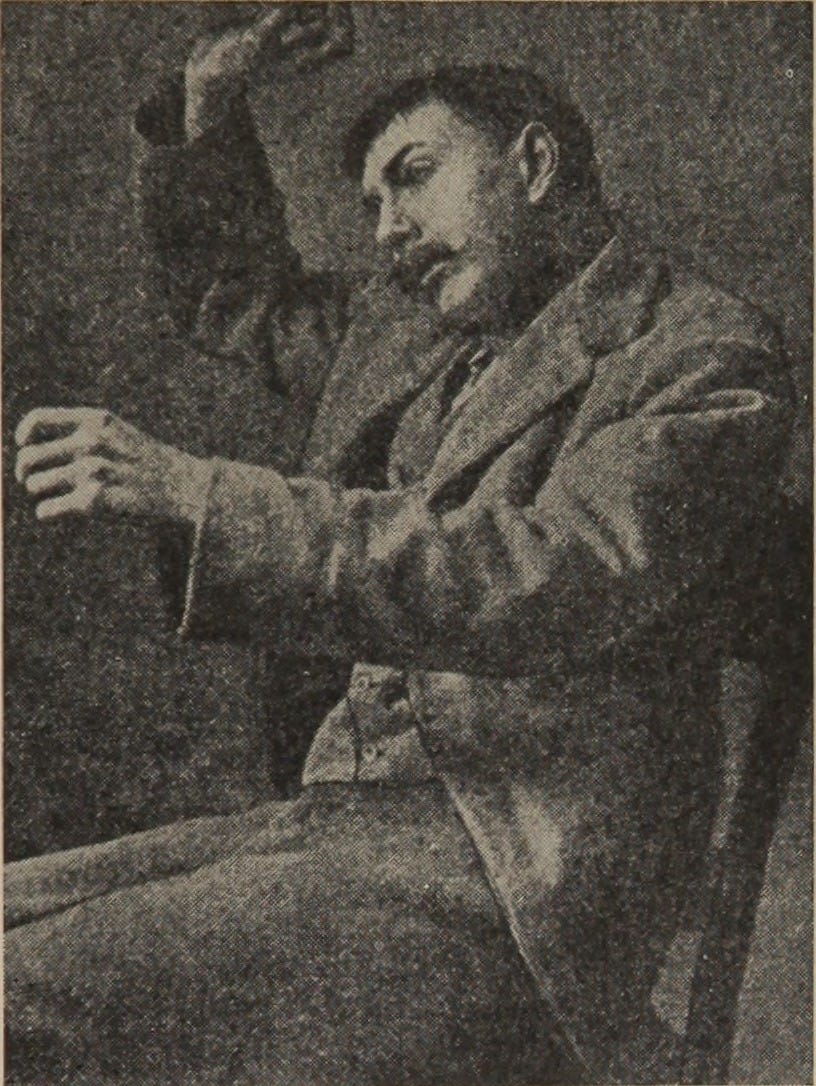
By medical definition, care of the Cleveland Clinic, we’ve come a little further in our understanding than mere “mental disorder.”
Echolalia is the repetition of words or phrases spoken by someone else. Children use echolalia as they learn how to communicate. It usually resolves by age 3, but may be a sign of developmental delay or an underlying condition if it continues or appears during adulthood. It’s common with autism spectrum disorder and Tourette syndrome.
I think it’s interesting that Lionel uses the term echolalia, which embodies echoing, repetition when he generally is more original than that. In his case, it’s the echolalia salad part that is key. How he might take the slightest hint of something heard, experienced, learned but then expand it into a whole riffed rap chorus of conjoined related letter-clusters from his past, present surroundings, imagination. His gang and gang leader call him a freak, but perhaps he is simply the young stove to compare to our Old Stove, cooking words and waxing poetic/frantic, reputation spreading by word of mouth.
To bring it all back to the motherless theme, let’s consider the Mother Tongue and what might happen in a mom’s absence. How might language take hold without the milk and nurturing of mothers? Early vocabulary and the primal mommas go hand in hand. In this case, the boys of Frank’s gang were lost boys, reared in an orphanage, supervised by television, the source of their education about women until they encountered real ones care of Frank. (It’s worth noting that Brooklyn is Fatherless too; Lionel spends the book trying to solve the mystery of the murder of his father figure who stepped in in the absence of any fathers or mothers.
But I think it’s the female magnet that draws out Lionel’s messy expression the most. The complicated intersection of words and women is where this novel starts to hum in ways unexpected, uncontrollable, alive.
[Appreciate what I produce here but don’t feel like committing to a paid subscription? Spare some change to Buy Me a Book.]
Sounds pretty great. Nice review!