


Back when I was obsessing over the small stuff—a stop motion shell with shoes on, lilliputian Webster dictionaries, and the like—my friend sent me this review of the film Backrooms, offering, she said, “more of the little things vibe.” The maze of spaces the character obsessively explores reduce to increasingly odd and confining, at the same time as seemingly infinite, in this odd indie horror made by a 20-year-old, which I thought better demanded its own topic someday.
So here I go putting a steaming bowl of creepypasta on the menu for the launch of my always thematic October in Sleepy Hollow.
What struck me in this sickening world-building of this Backrooms set design, was how familiar it is. How often I get struck by the same sort of queasy feeling amidst the buzzing lights and terrible office spaces we encounter so often in everyday life—from the low-budget fluorescent fast food storefront to the intolerable work environments some of us have to cubicle in.
Clark (played by Chiwetel Ejiofor) is the furniture store owner who disappears into the buzzing, windowless, claustrophobic, urine-colored backrooms of our collective nightmares that directly eminant from places we may recognize from Anywhere, Any Time. In this case, the entire movie premise was born from just this one photo that went viral on the internet in 2018 along with the mystery of solving from whence it sprang. For me, the off-kilter tilt and hum of this and simple hideousness elicits the same feeling as the startling twins in the dingy hallway of The Shining.
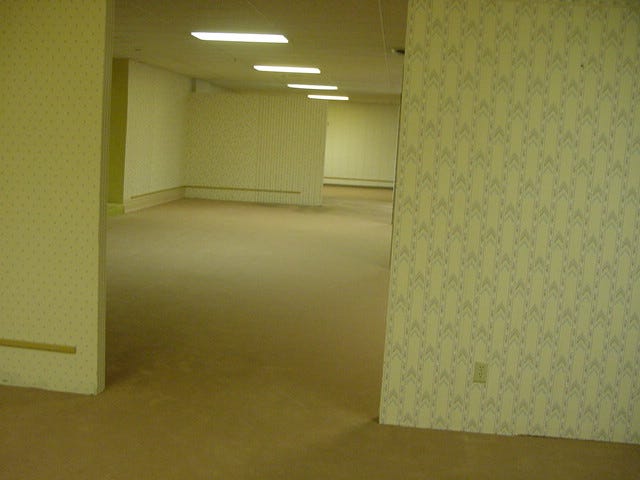
From this one “inspiring” picture (found eventually to be from Oshkosh, Wisconsin of all places), then teen Kane Parsons (AKA Kane Pixels) recreated digital spaces of a “Backrooms” bent for his YouTube channel that in turn captured millions of viewers.
Fast forward some years to 2026, and at the ripe age of mere 20, Kane has industry-backing to make a major motion picture of the same name.
The mythology of this whole phenomenon is catalogued in this mini-doc here:
As the story goes, a repost of that earliest eerie photo on 4chan’s Paranormal Export, inspired this convo between anonymous users. The first asked, “what is that?” To which the second said in riveting detail:
If you’re not careful and you noclip out of reality in the wrong areas, you’ll end up in the Backrooms, where it’s nothing but the stink of old moist carpet, the madness of mono-yellow, the endless background noise of fluorescent lights at maximum hum-buzz, and approximately 600 million square miles of randomly segmented empty rooms to be trapped in. God save you if you hear something wandering around nearby but it sure as hell has heard you.
And with that chilling piece of writing, the lore of the “backrooms” and the public’s fascination with creating, sharing, and exploring haunting liminal spaces was born with a hefty side of creepypasta.
What’s noclipping? “Noclipping comes from a video game design practice. It’s a type of cheat code baked into the test game that allows a player to quickly move between levels by passing through solid objects.”
The mini-documentary posits that the pandemic and lockdowns had a way of upping the ante on the collective sharing of memes—with so many newly abandoned airports, empty restaurants, unused corporate offices for our collective imaginations to fill. Throw in a hint or threat of some skulking monstrous/alien/ghostly entity in the background and you have real horror.
What’s creepypasta? According to Fandom, a brief history, that also begins in the nerdy online place I’ve never roamed called 4chan:
In the early days of the internet, the term was used to refer to a type of horror story written anonymously on places like 4chan, that was then passed around through other forums and websites to disturb, frighten, and entertain readers.
The name “creepypasta” (coined in 2007) comes from the word “copypasta”, a modern slang term for a portion of text that gets copied and pasted over and over again in online circles, typically for comedic and light-hearted purposes rather than to scare. This is how people shared creepypasta before the stories were collected and consolidated on sites like this one.
Creepypastas are sometimes supplemented with pictures, audio, and/or video footage related to the story, usually with gory, distorted, or otherwise unnerving content. Many of the most famous creepypastas incorporate some kind of accompanying media.
Nowadays, the term has broadened to the extent that any horror story uploaded to the internet can be a creepypasta.
Apparently these creepypastas have developed some tropes through the years (like finding lost footage and sharing a list of instructions for the reader) and some greatest hits characters such as Slenderman and the story of Squidward’s Suicide, along with those rooms of Backrooms themselves. Which helps teach everyone that you can get a motion picture deal someday if you do this weird stuff well enough.
To me, the term of “creepypasta” conjures that very noxious yellow itself, add some yellow butter or fake cheese spread and you’re literally golden. Part of the necessary vibe of these memes and online event of whatever form I think is somehow conveying the feeling of this terrible color. The sort of rancid yellow that conjures what the young director describes in an interview as
“the skin of the past.”
[Appreciate what I produce here but don’t feel like committing to a paid subscription? Spare some change to Buy Me a Book.]
The term creepypasta is almost adorable until you get into the origins of it, and also, I agree that it conjures up very unnatural margarine slathered pasta, maybe one with cracked dried corners. But that pale yellow, the term old flesh, it does have a decaying mummy like old bandage creep. Loved this on a rainy morning!